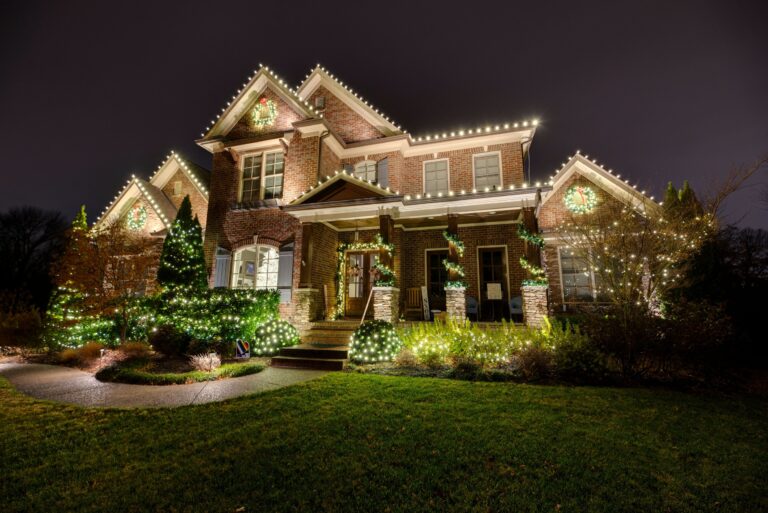
A roofline looks simple from the street. One line of lights along the edge, done. Then you get on a ladder and find the gutter lip is a different depth on the back of the house, the porch roof sits lower than the main roof, and the gable peak is a lot higher than it looked from the driveway. That is the real job, and it is why Nashville roofline lighting takes more planning than most people expect.
Nashville does not have one kind of house. In a single drive you can pass an old bungalow, a 1960s ranch and a new build with more roof angles than walls. Each one lights differently. Here is what we look at on each, and where DIY is perfectly fine.
Bungalows: short runs, lots of breaks
Older neighborhoods like 12 South and Sylvan Park are full of bungalows and cottages. The front usually has a low porch roof, a main roof behind it, and one or two gables or dormers. None of the runs are long. That sounds easy, but it means the lights start and stop many times.
What makes them tricky
- Every break needs an end. A strand that hangs past a corner or droops across a gap looks sloppy. On a bungalow, each run has to stop cleanly where the roof stops.
- Old edges are not uniform. Wood fascia, older gutters and decades of repairs mean the edge you clip to can change from one side of the porch to the other.
- Exposed rafter tails. Many Craftsman homes have open rafter ends under the eaves. The line of lights has to follow the gutter or roof edge above them, not wander down into them.
- Close neighbors. Lots are narrow. The side of the house may be a few feet from the fence, which limits where a ladder can go.
This is where custom cut strands earn their keep. We cut commercial grade LED strands to the length of each run, so a short dormer edge gets a short strand. Off the shelf strings come in fixed lengths, and the extra has to go somewhere. On a bungalow, that extra usually ends up bunched at a corner where everyone can see it.
Ranch homes: long, low and forgiving
The single story ranch is the easiest roofline to light well. You will find them across Nashville and out in places like Hendersonville and Gallatin, as well as older streets in Oak Hill and Forest Hills.
The eave line is long and mostly straight. It sits low, often within reach of a short ladder. There may be a garage bump out or a single front gable, but not much else.
Where ranches still go wrong
- Sag over long runs. A long straight edge shows every dip. If clips are spaced unevenly, the line waves. On a ranch, spacing matters more than on any other roof.
- Power at the far end. A wide house can put the only outdoor outlet at one end. Running a long line from a single outlet takes some thought about where the power actually comes from.
- Hip roofs. Some ranches have hip roofs, where every side slopes down and there is no flat gable end. The eave wraps all the way around. Most people only light the front, which is fine, but you have to decide where the line ends at each corner so it does not look cut off.
Honest answer: if you have a simple ranch, a steady ladder and a free Saturday, lighting the front eave yourself is a reasonable project. Use plastic clips that fit your gutter, space them evenly, and do not nail anything into the fascia. You will not get custom cut runs, but a single straight line is hard to get badly wrong. Where we help most on ranches is time, takedown and storage. Every install includes takedown after the holidays and off season storage, so the lights are not sitting in your garage all year.
New builds: steep, tall and busy
Many newer homes around Franklin, Brentwood and College Grove are a different job. A lot of them have two stories, steep pitches, several front facing gables and a mix of stone, brick and siding. Small rooflines stack on top of each other.
What they need
- A plan for which lines to light. A house with eight rooflines does not always look best with all eight lit. Sometimes the main gables and the lower eaves carry the whole look, and lighting every small valley just makes it busy. This is a design call, and design is part of every install.
- Height. Second story peaks on a steep roof are not ladder jobs for a homeowner. This is where DIY gets risky, and where we would tell you not to try it.
- Many short, angled runs. Gable edges meet at peaks and valleys. Each angle needs the strand to turn cleanly, and each run needs to be cut to its length.
- Mixed materials. Where a roof edge meets stone or brick, there is nothing to clip to. The line has to stop where the gutter or roof edge stops.
How we attach lights to any roofline
Whatever the roof, the attachment rule is the same. We use clips sized to the roof edge or gutter lip. We never put staples, nails or screws into fascia, trim or shingles. That matters for two reasons. It protects the house, and it means takedown leaves nothing behind. A roof that gets nailed for lights every winter ends up with holes that let water in.
Weather is the other reason attachment matters. Middle Tennessee winters bring wind and cold rain, and some years ice. Lights clipped to the right edge with the right clip stay put. If something does come loose during the season, in season maintenance is part of every install, and we back it with a 24 hour service guarantee.
What to tell us when you call
You do not need us to come out to get a price. We quote over the phone. Call (615) 595-9686, tell us about the house and what you want lit, and you can get a price on that call. It helps to know:
- Whether the house is one story or two.
- Roughly how many gables or peaks face the street.
- Which parts you want lit: the front eave only, the full front, or more.
- Whether there are gutters along the edges you want lit.
- Where your outdoor outlets are.
If the property is large or unusual, or you would just rather talk it through in person, a site visit is available. It is an option, not a requirement. You can also send the details through our quote form.
The short version
- Bungalows: short runs, lots of clean stops, older edges. Custom cut strands make the biggest visible difference here.
- Ranches: the most DIY friendly roof. Even clip spacing is the whole game.
- New builds: height and complexity. Decide what not to light, and leave the second story peaks to a crew.
Red Nose Lites is a family owned company that has been lighting Nashville homes since 2006. We do Christmas and holiday lighting only. There are no contracts and no long term commitments. If you want to see how an install runs from first call to takedown, read how it works, or look at our residential installation page. When you are ready, get a quote or give us a call.
Want your home to look like this?
Red Nose Lites designs, installs, maintains and takes down custom Christmas lighting across Nashville and Middle Tennessee. No ladders, no tangled strands, no storage.
Get a Free Quote