
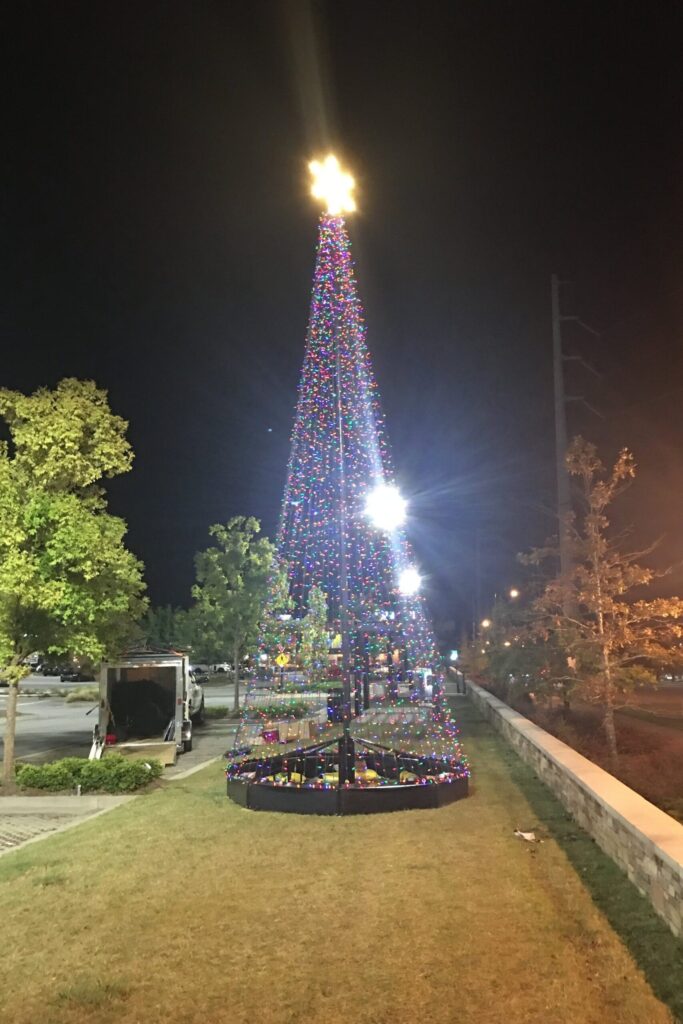
Stand at the curb after dark and look at two houses on the same street. One roofline reads as a single clean line of light. The other has a dark notch at the corner, a bright knot of doubled bulbs above the garage, and a soft droop in the middle of the longest run. Same bulbs, often the same color temperature. The difference is almost never the product. It is whether the strand was cut to the house or the house was made to accept the strand.
That is the whole argument for custom cut christmas lights. It is not a premium feature. It is the thing that decides whether the finished job looks intentional.
What custom cut actually means
A retail light set is manufactured in fixed lengths. You buy the length on the box and that is what you get. A custom cut strand starts as bulk wire and bulk sockets. The installer measures the run, cuts the wire to that measurement, and terminates the end. The strand is built for one specific edge of one specific house.
Every Red Nose Lites install uses custom cut commercial grade LED strands. That is part of the standard job, not an upgrade line. The measuring happens once, the strands get built to those numbers, and the same strands come back to the same roofline the following year.
Three things go wrong when the strand does not match the run
Gaps at the corners
Corners are where a fixed length set fails first. A roofline is a series of runs that meet at angles, and almost none of those runs happen to be the length of a manufactured strand. So the installer either stops short and leaves a dark gap before the corner, or splices in a second set and creates a visible seam.
A gap of even a few inches at a corner is the most noticeable defect on a house at night, because a corner is exactly where the eye expects the line to turn. Break the line there and the whole roofline stops reading as one shape. A custom cut strand runs to the end of the run and stops where the roof stops. The turn stays lit.
The extra footage has to go somewhere
The opposite problem is more common. You have a run that needs slightly less than the length you bought, so there is leftover wire. It does not disappear. It gets looped back on itself, bunched behind a downspout, coiled at the end of a gable, or doubled over the last few feet of gutter.
In daylight nobody sees it. At night that coil is three or four times the bulb density of the rest of the run, so it reads as a hot spot. The eye goes straight to it. Nashville has a lot of homes with multiple gables and dormers, and each one of those is another run that ends in leftover wire. On a house with six or seven separate runs, the bunching adds up into something that looks careless even though every individual choice was reasonable.
Sag between attachment points
Sag is partly a wire problem and partly a clip problem. A strand that is too long for its run has slack in it by definition, and slack becomes a droop between the points where it is fastened. Add a week of wind and a couple of freeze cycles and the droop deepens.
Middle Tennessee weather is hard on this. A season here runs through wind, heavy rain, a few hard freezes, and the occasional ice event, and the temperature can swing thirty degrees in a day. Wire expands and contracts. A run installed with slack in November has more slack in January. A run cut to length starts tight and has far less to give.
The cut and the clip are one decision
Cutting the strand correctly only helps if the strand is then held correctly. Red Nose Lites uses clips sized to the specific roof edge or gutter lip on that house. Nothing gets stapled, nailed or screwed into fascia, trim or shingles. That is a firm rule and it is worth understanding why.
A staple through a strand is a permanent decision made with a temporary product. It puts a hole in the wire jacket where water will sit, and it puts a hole in your fascia that stays there in July. Nail holes in trim are a repainting job. Anything driven into shingles is a leak waiting for the right storm. A clip sized to the edge carries the load along the gutter lip or the shingle edge and comes off in January without leaving evidence.
The clip is also what controls sag on a correctly cut strand. Right length plus right spacing on the clips is what produces the straight line you were picturing when you decided to hire this out.
When a store bought set is fine
Not every house needs custom work, and it is worth saying so plainly.
- One straight porch rail. Buy a set, zip tie it, enjoy it.
- A single small tree or a pair of shrubs. Wrapping is forgiving and nobody is measuring.
- A simple single story ranch with one uninterrupted front run, if you are comfortable on a ladder and you accept that the ends may not land perfectly.
- Anything at ground level where you can adjust it yourself in thirty seconds.
Where the math changes is height and complexity. Two story rooflines, steep pitches, multiple gables, dormers, and long gutter runs with turns in them are where fixed lengths start compounding into gaps and coils, and where the ladder work stops being a Saturday project. That is also where a fall is a real risk rather than an inconvenience.
Cut once, used for years
The part that surprises people is what happens after the holidays. Red Nose Lites takes the lights down after the season and stores them off season. The customer does not keep a box of tangled strands in the garage.
That matters here because those strands were cut for your house. Stored properly and labeled, the same measured runs go back up the next season on the same edges. The measuring work is done once and it keeps paying. Compare that to a bin of retail sets that get pulled out every November with a few dead sections and no memory of which one went where.
Every install also includes design, installation by insured crews, and in season maintenance with a 24 hour service guarantee if something goes out. There are no contracts and no long term commitments.
Getting a price on your roofline
You do not need to schedule anything to find out what this costs. Call (615) 595-9686, describe the house and which parts you want lit, and you can get a price on that call. If your property is large or unusual, or you would simply rather someone look at it in person, a site visit is available. It is an option, not a requirement.
You can also start with the form at rednoselites.com/get-a-quote/, or read through how the process works before you call. For homes, the details are on the residential installation page.
Red Nose Lites has been doing this in Nashville since 2006, with more than 20 years of experience in holiday lighting, and works across Nashville, Brentwood, Franklin, Green Hills, Belle Meade, Hendersonville and Gallatin.
Want your home to look like this?
Red Nose Lites designs, installs, maintains and takes down custom Christmas lighting across Nashville and Middle Tennessee. No ladders, no tangled strands, no storage.
Get a Free Quote