
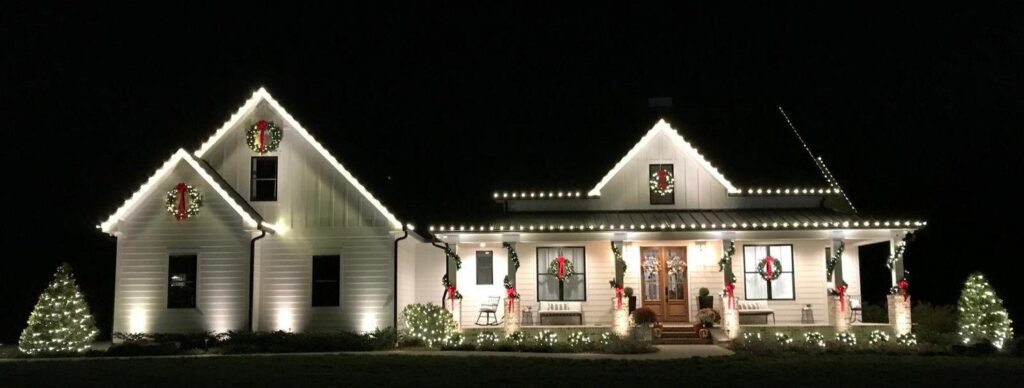
Every strand of lights on a roofline is held up by something. That something decides whether your fascia board looks the same in March as it did in November. Clips are the boring part of a Christmas light install and the part that matters most.
This is a plain look at what christmas light clips actually do, which clip belongs on which edge of a house, and why staples and nails keep turning up on Nashville rooflines even though the damage they cause outlasts the season by years.
What a clip is actually for
A clip has one job. Hold a bulb or a wire at a fixed angle without putting a hole in anything. A good clip grips an edge that already exists: the lip of a gutter, the exposed edge of a shingle, the cap on a ridge. It slides on, it holds by tension or by a hook, and it comes off in January leaving nothing behind.
That last part is the whole point. A clip is a temporary fastener for a temporary display. Anything that pierces the building is permanent damage traded for a few weeks of light.
Clips also control how the line looks. A bulb seated in a clip points the same direction as the bulb next to it. Wire wrapped around a nail points wherever the wire felt like pointing. From the street, an even line of C9s reads as finished work and a wandering line reads as a rush job. Same lights, same house, different hardware.
The clip families, and where each one belongs
There is no single clip that works on every edge of a house. A normal roofline needs two or three types on the same run, and swapping between them at the right moment is most of the skill.
Shingle tab clips
These slide up under the bottom edge of a shingle and hold the bulb facing out or facing up. They are the standard for a roof edge with no gutter, and for a second course above a gutter when you want a double line. They need a shingle edge that will lift slightly without cracking. On old or brittle asphalt in cold weather, that is a real consideration and not a given.
Gutter clips
These hook over the front lip of the gutter. On most homes around here the gutter is the cleanest path for a straight line across the front of the house, and a gutter clip carries both the wire and the bulb without touching the roof at all. If a gutter is loose, sagging, or holding standing water and leaves, that is worth knowing before anything gets hung from it.
All in one clips
These are cut to work either way, shingle or gutter, usually with a socket for the bulb and a separate channel for the wire. They earn their keep on a mixed roofline where a single run crosses from gutter to open shingle edge and back again.
Ridge and peak clips
Ridges, peaks and hips need a clip that straddles the cap rather than hooking one edge. On a steep roof with several gables, the ridge is often the line people actually see from the road. It is worth doing with the correct piece instead of improvising with whatever is left in the box.
Brick, trim, columns and windows
Not everything that gets lit is a roof. Window frames, porch columns, beams and masonry each need their own approach. Brick clips grip the mortar joint. Adhesive clips hold on smooth painted trim and glass. What none of them should involve is a hole in the material.
What staples and nails actually do
Staples and nails are fast. That is the entire argument for them, and it is not enough.
- Fascia and trim. A staple through painted wood breaks the paint film. Water follows the hole in, the wood swells, the paint lifts around the puncture, and rot starts in the one place on the house that is hardest to inspect. One staple is nothing. Forty staples a year for ten years is a fascia board.
- Shingles. A nail driven through a shingle punctures the surface whose only job is shedding water, and it does it at the roof edge where wind driven rain hits hardest. A shingle is not designed to be perforated on purpose every autumn.
- The wire itself. A staple crimped over a light strand can pinch through the insulation and into the conductor. Sometimes that kills the section immediately. Sometimes it sits there working fine until a cold, wet night in December, which is worse.
- Takedown. Staples and nails create a bad choice in January. Leave them in the wood, or pull them and take a chip of paint with each one. Most people leave them. The next crew works around a roofline studded with old metal.
None of this shows up the first season. That is exactly why it keeps happening.
When doing it yourself is fine
Plenty of this job does not need a crew. A single story porch, one run of gutter you can reach safely from a step ladder, a couple of window frames: buy a box of clips that matches your bulb size, use one clip per bulb, and you are done in an afternoon. Clips cost very little. Running them sparsely to save a few dollars is the most common DIY mistake, and it is what produces sagging lines by mid December.
Where it stops being sensible is height and pitch. A steep second story roof, a wet or frozen shingle, or a spot where a ladder cannot be footed safely is not a place to save money. Same with a house that needs someone back on the roof mid season when a section fails. Be honest with yourself about which one you have.
How we handle fasteners
Red Nose Lites has been doing this in Nashville since 2006, and the rule is simple. Clips are sized to the specific roof edge or gutter lip on the house. Never staples, never nails, never screws into fascia, trim or shingles. Strands are commercial grade LED, custom cut to the run so there is no excess wire looped and stuffed at the corners.
The fastener decision is made on site by the crew installing, because the right clip for the front gutter is often the wrong clip for the gable above it. That is also why installation, in season maintenance, takedown and off season storage are all part of the same service. The crew that put the clips on is the crew that takes them off, and the lights come back to us for storage rather than into your attic.
You can read the full process on how it works, or look at what is covered under residential installation. We work across Nashville, Brentwood, Franklin and Green Hills, among other areas.
Getting a price
Call (615) 595-9686 and describe the house: how many stories, roof edge or gutter, how much of the front you want lit, whether the peaks are included. You can get a price on that call. If the property is large or unusual, or you would simply rather have someone walk it with you, a site visit is available, but it is an option and not a requirement.
You can also send the details through the quote form. There are no contracts and no long term commitments, and there is a 24 hour service guarantee during the season, so if a section goes dark in the second week of December someone comes out and fixes it.
Want your home to look like this?
Red Nose Lites designs, installs, maintains and takes down custom Christmas lighting across Nashville and Middle Tennessee. No ladders, no tangled strands, no storage.
Get a Free Quote