Three bulb sizes cover almost every Christmas light job we do around Nashville: C9, C7 and mini lights. Homeowners usually ask which one is best. There is no best. There is a right size for a given roofline, a given tree and a given viewing distance. Getting that wrong is the most common reason a house that cost real money to light still looks flat from the street.
The three bulbs, plainly
C9
The C9 is the big one. It is the classic strawberry shaped bulb people picture when they think of an old fashioned Christmas roofline. It sits in an intermediate socket and throws a large, distinct point of light. On a commercial grade LED strand the bulb is faceted plastic, so it catches light and sparkles a little instead of glowing flat.
C9 is the default for rooflines, and the reason is viewing distance. If your house sits back behind a deep front yard, or you are on a corner lot where people see you from two directions, C9 is the size that still reads as a clean line of light from across the street. Smaller bulbs at that distance start to blur into a smear.
C7
The C7 is the same shape, smaller, on a candelabra base. It is roughly the size of an old night light bulb. It gives you the same defined bulb look as a C9 with less visual weight.
C7 suits smaller houses, single story ranches, and homes where the roofline sits close to the sidewalk. On a compact bungalow in 12 South or Sylvan Park, a C9 can look heavy and slightly out of scale, and a C7 keeps the proportions honest. C7 is also the better detail bulb: door frames, window trim, garage surrounds, a porch edge, the top rail of a pergola.
Mini lights
Mini lights are the small bulbs on tight spacing. They are not a roofline product in most cases, and a roofline done entirely in minis usually disappears from any real distance. What they are good at is wrapping. Trees, trunks, branches, porch columns, railings, wreaths and garland are all mini light work.
The tight spacing is the point. On a wrapped trunk or a railing you want a continuous glow rather than a row of separate dots, and minis are the only one of the three that gives you that at close range.
Rooflines, trees and railings
The simplest way to decide is to stop thinking about bulbs and start thinking about surfaces.
- Main roofline, gutters, peaks and gables: C9 on most two story homes, C7 on smaller or closer to the road homes.
- Windows, doors, garage trim, porch edges: C7, because the detail is viewed from closer up and does not need the reach.
- Trees, columns, railings, shrubs: mini lights, wrapped rather than run in a line.
- Long commercial frontage and multi story buildings: C9, for the same distance reason, only more so.
Most homes end up using at least two of the three, and that is normal rather than a compromise.
Spacing changes the look more than the bulb does
Two houses can run the exact same C9 bulb and look nothing alike, because spacing is the other half of the decision. Wider spacing gives you separated points of light and a more traditional, slightly sparse look. Tighter spacing pulls those points into something closer to a solid ribbon along the edge of the roof.
Neither is correct. It depends on the length of your runs and how busy the house already is. A long, plain roofline can carry wider spacing and still look deliberate. A roofline broken up by dormers, gables and short jogs usually wants tighter spacing so each short run still reads as a run.
This is where custom cut strands do the quiet work. Every strand we install is cut to your house, so a run ends exactly where the roofline ends. No leftover tail dangling off the corner, no dead gap where the strand ran out three feet short, no extension cord doing a job it should not be doing. Off the shelf strands come in fixed lengths and your roof does not.
Warm white, cool white or color
Warm white reads traditional and looks right against wood, cream trim and older brick. Cool white reads crisp and modern and holds up well against dark trim, stone and painted brick. Color is a taste question, though color usually works better as an accent on trees and wrapped elements than as a full roofline treatment.
The one rule worth following: do not mix warm white and cool white on the same plane. On the same roofline they do not read as a design choice. They read as a repair.
When doing it yourself is fine
Wrapping a couple of front shrubs, a porch column or a railing with minis is a decent Saturday. You do not need a crew for that, and we are not going to pretend you do. If that is the extent of what you want, buy good strands and enjoy the afternoon.
What changes the math is height and pitch. Two story rooflines, steep pitches, ladder work over concrete or a sloped driveway, and anything that involves standing on a roof in December: that is where the job stops being a hobby. Nashville winters bring wet weeks, freezing rain and enough wind to matter, and a wet roof in the dark is exactly the wrong place to learn your limits.
How the bulbs actually get attached
Whatever size you land on, the attachment matters more than the bulb. We use clips sized to your roof edge or gutter lip. Never staples, never nails, never screws into fascia, trim or shingles. Fasteners driven into your trim leave holes that outlast the season by years, and they are the main reason a homeowner ends up with rot in a spot that was fine before anyone put lights on it.
Clips also survive the freeze and thaw cycles we get here. A strand that shifts a few inches after the first ice looks crooked for the rest of December, and crooked is what people actually notice from the street.
What comes with the job
Every install includes the design, custom cut commercial grade LED strands, installation by insured crews, maintenance during the season, takedown after the holidays and off season storage. We store the lights. You do not give up a corner of the garage to a tangle of strands in January.
There is a 24 hour service guarantee during the season, so if a run goes dark in the middle of December it gets handled. There are no contracts and no long term commitments. Red Nose Lites is family owned in Nashville and has been doing this since 2006, with more than 20 years of experience behind the crews. You can see the process in more detail on how it works and on the residential installation page.
Picking the size for your house
You do not have to work this out alone, and you do not have to wait for someone to come look at the house first. Call (615) 595-9686, describe your home, the roofline, the trees you want lit and the look you are after, and you can get a price on that call. If your property is large or unusual, or you simply want someone to walk it with you, a site visit is available. It is an option, not a requirement.
We cover Nashville, Brentwood, Franklin, Hendersonville, Gallatin, Belle Meade, Green Hills, 12 South, Sylvan Park, Hillwood, Forest Hills, Oak Hill and College Grove, plus Mount Juliet, Nolensville and Murfreesboro. If you would rather write it down than talk it through, use the quote form and we will follow up.
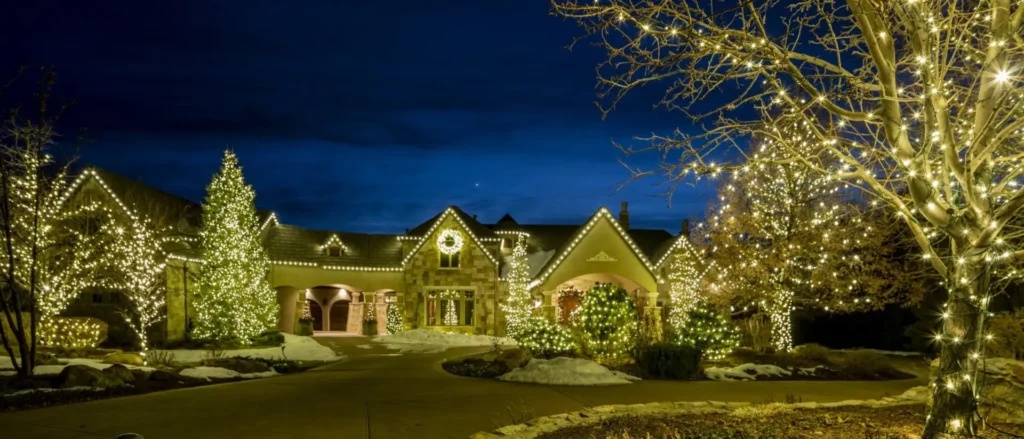
Want your home to look like this?
Red Nose Lites designs, installs, maintains and takes down custom Christmas lighting across Nashville and Middle Tennessee. No ladders, no tangled strands, no storage.
Get a Free Quote