
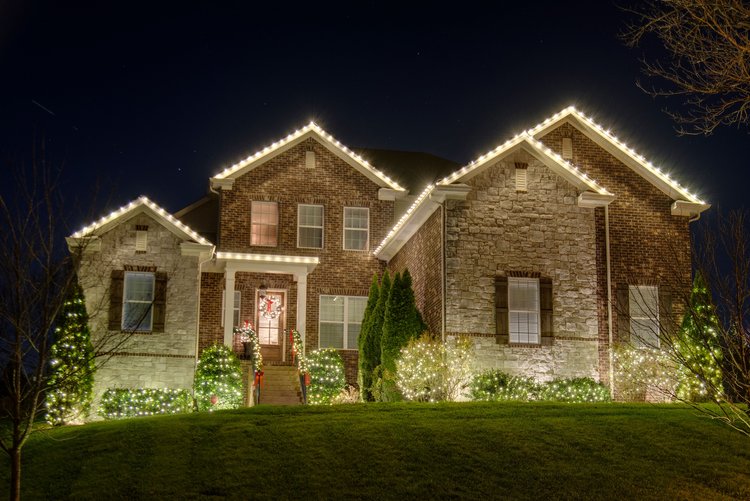
Roof pitch decides how a Christmas light install actually gets done. Two houses can need almost the same footage of strand and still be completely different jobs. A single story ranch with a shallow pitch and firm ground on all four sides is straightforward. A two story house with a steep gabled front, a dormer over the entry and a gutter line 20 feet up is not.
What counts as a steep roof
Roof pitch is written as rise over run. A 4/12 roof rises four inches for every twelve inches it runs. Most people can walk a 4/12 or a 6/12 in dry conditions. Somewhere around 8/12 the roof stops being a surface you stand on and becomes one you work off of, with your weight held by something other than the grip of your shoes. At 12/12, a 45 degree angle, you are not walking anywhere at all.
Plenty of homes in Forest Hills, Belle Meade and the older streets of Green Hills sit in that steeper range, especially anything with a tall front gable or a tile or slate profile. Newer builds often pair a steep front elevation with a shallower back, so one house can be easy on one side and serious on the other.
Height matters too, but not the way people assume. A fall from 12 feet onto a driveway is not a safe fall. The extra risk on a second story install is less about the drop and more about everything that gets harder up there: ladder angle, reach, carrying material, and the fact that you cannot simply step off when something starts to go wrong.
The ladder is usually the real problem
Most of the risk in this work sits on the ladder, not on the roof. The failures are boring and repeatable. The base gets set too close to the wall, so the ladder kicks out. It gets set on soft ground or wet leaves and settles under load. It does not reach far enough past the roof edge, so getting on and off is a stretch instead of a step. Someone reaches sideways rather than climbing down and moving it, because repositioning for the tenth time is tedious.
The rules that hold up are simple. Set the base one foot out for every four feet of height. Extend the top about three feet above the edge you are stepping onto. Never let your belt buckle pass outside the side rails, because reaching wide is what tips ladders over.
What you are actually paying for
On a steep or tall roof, the value of hiring the work out is not that a crew can hang a strand you could not. It is insurance, preparation and repetition.
Red Nose Lites has been doing holiday lighting in Nashville since 2006, which is more than 20 years of this same work every fall. The crews are insured. That matters in a way that is easy to skip past: if someone is hurt on your property while working for us, that sits with us, not with your homeowner policy. A neighbor with a truck and an extension ladder is a very different arrangement, and most people never think about it until something happens.
The other half is that the design is settled before anyone climbs. Strands are custom cut to the run they are going on, so a peak or a dormer gets a piece made to fit instead of a factory length that leaves a tail dangling or falls two feet short. Cutting on the ground and carrying up a finished section is faster and safer than working it out at the top of a ladder.
Clips, never fasteners
Strands go up with clips sized to the roof edge or the gutter lip. Nothing is stapled, nailed or screwed into fascia, trim or shingles. That is the difference between a clean takedown in January and a row of small holes in your fascia board that you notice in April.
Staples are especially tempting on a steep roof, because a strand on a steep pitch genuinely does want to slide, and a staple is what a tired person reaches for to make it stop. The real fix is the correct clip at the correct spacing. A staple also damages the wire jacket, which you will not notice until the run goes dark two weeks later.
Nashville weather is part of the job
Installs here run from late fall into December, and that means frost. A roof that is walkable at two in the afternoon can be glazed at nine the next morning. Wet leaves on a shingle behave a lot like ice, and November here brings stretches of rain that leave everything damp for days. A damp composite shingle on an 8/12 pitch has almost no grip left.
That is the practical argument for booking early rather than in mid December. The earlier the install, the more workable days there are to pick from.
When doing it yourself is fine
Plenty of houses do not need a crew, and there is no reason to pretend otherwise. If your roof is single story, the pitch is shallow, the ground around it is level and firm, and you can reach every run from a stable ladder without stretching, do it yourself. Buy decent clips, plan the runs before you open a box, and have someone foot the ladder.
It stops being worth doing yourself when any of these are true:
- The run is on a second story, or the gutter line is above 15 feet.
- The pitch is roughly 8/12 or steeper.
- There are peaks or dormers you cannot reach from a ladder on flat ground.
- The only ladder placement is a slope, a deck rail, mulch or soft ground.
- The roof is tile or slate. Those break underfoot, and one cracked tile can cost more than the whole lighting job.
None of that is an argument for lighting the peak. If the top of a steep roof is genuinely hard to reach, a clean gutter line with lit windows and landscaping often reads better from the street anyway, and it costs less. Ask about that before assuming you need the whole outline.
What happens after the install
The part people forget is that a steep roof is still steep in January. Every install includes in season maintenance, so a section that goes dark is our climb, not yours, and there is a 24 hour service guarantee during the season. Takedown is included, and so is off season storage. We keep the lights, so they do not spend a Tennessee summer in your attic.
There are no contracts and no long term commitments. The full sequence is on the how it works page, and what a home install covers is on the residential installation page.
Getting a price on a steep roof
You do not need to wait for anyone to come out. Call (615) 595-9686, describe the house, and you can get a price on that call. It helps to have a few things ready:
- How many stories, and whether the front and back differ.
- Roughly how steep the front roof is. “Shallow”, “steep” or “very steep” is enough.
- Whether you want the roofline only, or peaks, dormers, windows and landscaping too.
- Anything limiting where a ladder can sit: a bay window, a deck, a steep yard, beds planted tight to the wall.
If you would rather have someone look at it in person, that is available, particularly on larger or unusual properties. It is an option, not a requirement. You can also send the details through the quote form.
We install across Nashville, Brentwood and Franklin, plus Hendersonville, Gallatin, Green Hills, Oak Hill, College Grove, Mount Juliet, Nolensville and Murfreesboro.
Want your home to look like this?
Red Nose Lites designs, installs, maintains and takes down custom Christmas lighting across Nashville and Middle Tennessee. No ladders, no tangled strands, no storage.
Get a Free Quote