
Almost every piece of Christmas light advice on the internet assumes you have asphalt shingles. So does almost every clip sold in a hardware store. The standard shingle clip is a small hook that slides up under the bottom edge of a shingle course and grips the lip. It works because an asphalt shingle is flexible, forgiving and cheap to replace if you tear one.
Slate and tile are none of those things. If you have a slate roof and you hand a crew a bag of shingle clips, you are asking them to force a tool into a material it was never designed for. This is the post about what actually happens up there, and what we do instead.
Slate is stone, and stone splits
A slate tile is a thin sheet of rock, often less than a quarter inch thick, hung on nails and overlapping the course below. It is strong when you press flat against it and weak when you pry, twist or lever at the edge. That is exactly what a shingle clip does. The clip is designed to be pushed under a course and then to spring open and hold. Slate does not spring. It resists, and then it splits along its natural grain, usually in a line running up the tile where you will not see it from the ground until water starts showing up in an attic in February.
Clay and concrete tile fail differently but just as easily. A barrel or S tile is strong across the middle of its span and brittle at the nose and the corners, which is the part that hangs out over the edge and the part a clip wants to grab. Old clay in particular gets more fragile with age, and Nashville freeze and thaw cycles do not help.
The other thing worth saying plainly: on both materials, the individual pieces are load bearing for the pieces around them. Crack one slate and you have not just made one hole. You have taken support away from its neighbors.
The clip is not the biggest risk. Feet are
Here is the part most homeowners do not expect. If a slate roof gets damaged during a light install, the most likely cause is not the clip at all. It is somebody walking on it.
Slate is slick when it is wet, and in Nashville in November and December it is often wet. A person carrying a coil of light strand, leaning to reach a valley, puts their full weight on one or two tiles at a time. Tile roofs are worse. Walking a clay tile roof requires knowing exactly where the batten is under your boot, and getting that wrong cracks tile in a way you can hear.
So the real question to ask any installer is not just what clip they use. It is how much time they intend to spend standing on your roof. The right answer on slate and tile is: as little as possible, and ideally none.
What we use instead
Our rule does not change by roof material, which is the point. We attach with clips sized to the roof edge or the gutter lip. We never use staples, nails or screws into fascia, trim or shingles. Nothing gets driven into your roof, so there is no hole to seal in January and no fastener left behind after takedown.
On a slate or tile house that rule does most of the work for us. The gutter is the main line of attachment. Gutter clips hang from the metal lip and carry the strand along the run without touching the roofing material at all. Where a home has a strong gutter line, a slate roof is genuinely easy to light, because the lights never make contact with the slate.
Where it gets more involved is a house with no gutters, a hidden or built in gutter, or a roofline where the good visual line is a rake edge or a ridge rather than the eave. Those are real design problems, and the answer is usually to change the design instead of forcing hardware onto the slate. Sometimes that means running the main line along the gutter and picking up the vertical interest with columns, porch details, trees and shrubs. A lit roof edge plus lit trees reads better from the street than a lit roof edge alone, so this is rarely a downgrade.
You can see how we work through a property on our how it works page, and the scope of a normal home job on our residential installation page.
When you should just do it yourself
We will say this even though it is our own service: if you have a slate or tile roof and what you actually want is a lit porch, a wrapped column, a wreath and two lit trees, that is a good DIY weekend. All of it happens at ground level or off a short ladder. None of it touches the roof. You do not need us for that, and you should not pay anyone for it.
Where hiring out starts to make sense is when you want the roof edge itself lit, when the run is two stories or higher, when the roofline is cut up with dormers and valleys, or when you simply do not want to be on a ladder in the cold. That is the job we do, and on slate and tile it is worth having someone insured on the property.
What to tell us when you call
We quote over the phone. Call (615) 595-9686, describe your house, and you will get a price on that call. You do not need to schedule anyone to come out first. If you want a site visit, or if the property is large or unusual, we can do that too, but it is an option and not a requirement.
For a slate or tile house, a few details make the phone quote much more accurate:
- The roof material. Real slate, synthetic slate, clay tile and concrete tile all behave differently. If you are not sure, say so, that is fine.
- Whether you have gutters, and where. Full gutter runs, partial, or none at all changes the plan more than anything else.
- Height. One story, two, or a steep three story gable end.
- What you want lit. Roof edge only, or roof plus columns, trees, wreaths and walkways.
- Anything that already broke. If a previous crew cracked something, tell us, so we plan around that section.
If you would rather not call, there is also a quote form.
What the job includes
Every install includes design, custom cut commercial grade LED strands, installation by insured crews, maintenance during the season, takedown after the holidays, and off season storage. We store the lights, so you are not finding a tangled box in the garage next October.
There is a 24 hour service guarantee during the season, so if a run goes dark in the middle of December it gets handled. There are no contracts and no long term commitments.
We install across Nashville and the surrounding area, including Belle Meade, Forest Hills and Green Hills, where older and more architectural roofs are common.
Red Nose Lites is family owned in Nashville and has been doing this since 2006, with 20+ years of experience behind the crews. If your roof is slate or tile, say that on the first call. It changes the plan, and it is much easier to plan for than to repair.
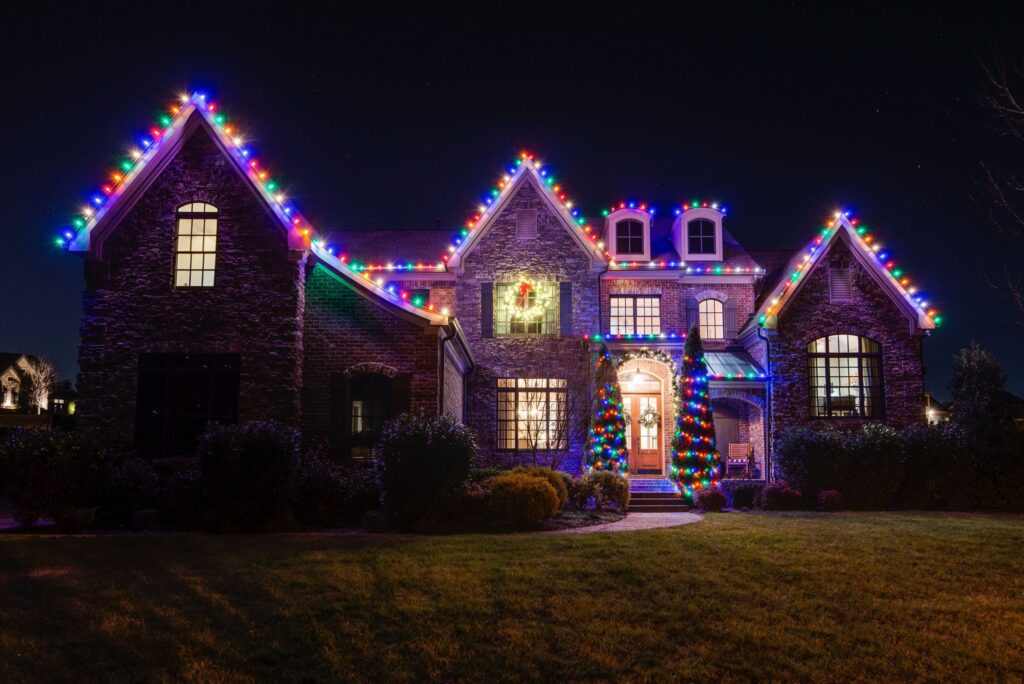
Want your home to look like this?
Red Nose Lites designs, installs, maintains and takes down custom Christmas lighting across Nashville and Middle Tennessee. No ladders, no tangled strands, no storage.
Get a Free Quote