
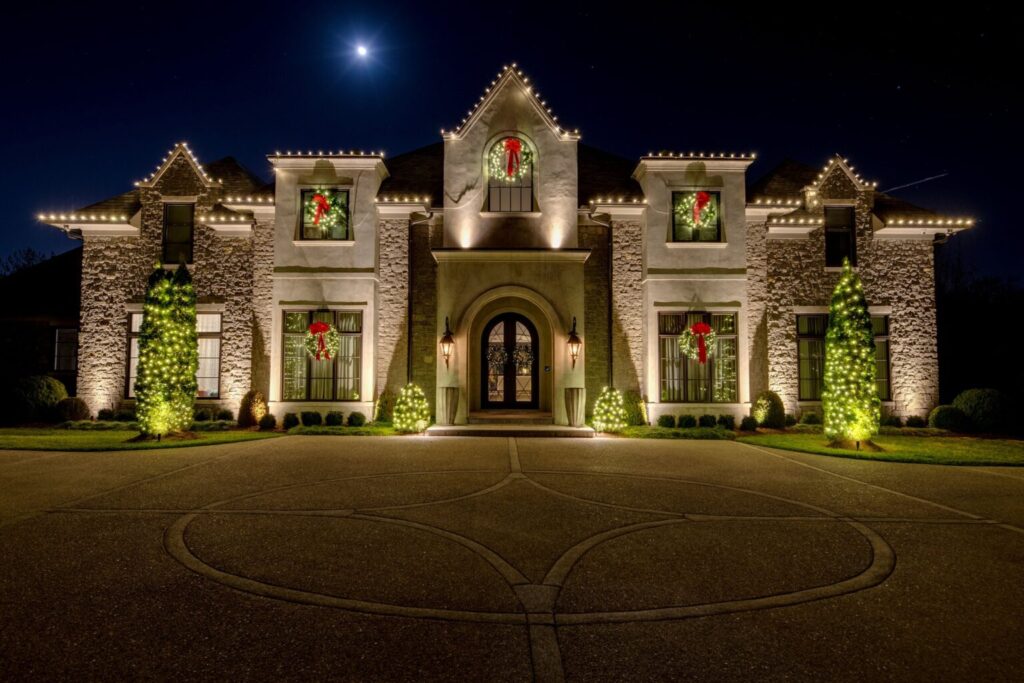
A clean run of LED strands along the roofline does most of the work on a house. Wreaths, garland and bows are what people add afterward, and they are also the part that most often looks off. Usually the piece is too small, hung too high, or made of a material that gives up after the first freezing rain. Here is how to size christmas wreaths garlands and ribbon for a Nashville house, where they belong, and what actually lasts through a Middle Tennessee winter.
Proportion is what people get wrong first
Almost every decor mistake is a scale mistake. A wreath that looks enormous in your hands reads as a doorknocker from the curb. Buy for the curb, not the store aisle.
Wreaths
- A useful rule of thumb: the wreath should be somewhere between half and two thirds the width of the door.
- On a standard single front door, a 24 inch wreath reads correctly from the street. An 18 inch wreath tends to look like an accident.
- Double doors, or a single door flanked by sidelights, want more. Think 30 inches and up, or two matched wreaths hung at the same height.
- Hang the center at roughly eye level or a little above, not up in the top panel of the door. Too high is the most common error and it leaves the door looking bare underneath.
Garland
With garland, thickness matters more than length. A thin, wiry garland wrapped around a heavy porch column disappears. If the column is substantial, use a full garland, often two runs twisted together. Measure the path the garland will follow, then add roughly a third for the swag and the wrap. Garland pulled tight and straight looks like a rope. Garland with a gentle drop in the middle looks intentional.
Placement: fewer pieces, bigger pieces
One strong wreath on the front door beats four small ones scattered around the porch. The same goes for garland. Pick the lines the eye already follows and dress those.
- Good places for garland: the door surround, porch railings, columns, a lamppost, a mailbox post, a stair rail leading up to the entry.
- A bad place for garland: the roofline. That is what the lights are for. Garland along a roof edge sags between fixing points, holds water, gets heavy, and pulls on whatever is holding it.
- Second story windows: either every window on the front elevation gets a wreath, or none do. Half a row reads as unfinished from the street.
Viewing distance changes everything. Close to the sidewalk, detail is visible and a wreath with real texture pays off. On a property set well back from the road, common around Belle Meade and Forest Hills, only the silhouette reads. Scale up and skip the fine detail nobody can see.
Bows are the part that fails first
Greenery holds up reasonably well. Bows do not. They fade, they crush, they untie, and by New Year they are the reason a display looks tired.
- Use wired ribbon. Unwired ribbon cannot hold a loop once it gets wet. Wired edges let you reshape a bow after a storm instead of retying it.
- Skip velvet outdoors. It looks best on day one and worst by week three. It crushes, it holds water, and it spots. Weatherproof polyester or a coated outdoor ribbon keeps its shape.
- Cut the tails on an angle and keep them short enough that they do not whip. Long tails on an exposed corner get shredded by wind.
- Attach with the wire that formed the bow, twisted around something solid. Not tape. Tape lets go the first time it gets cold and wet.
- Expect reds to fade. Sun on a south facing door turns red ribbon pink. Plan on replacing bows more often than greenery.
What a Middle Tennessee winter actually does to it
Nashville does not give you a consistent cold season. You get 60 degrees one week, freezing rain the next, then sun. That cycle of wet, frozen and thawed is harder on decor than a straightforward deep freeze would be. Two things to plan around: water weight, because soaked greenery gets much heavier than it is dry and whatever holds it needs to handle the wet weight, and wind, because corners, open porches and anything above the first floor take far more of it than a sheltered front door.
Real greenery or artificial
Honest answer: real cedar and fir smell good and look better than artificial for about three weeks. After that they brown, they drop, and on a sunny door they go fast. Artificial greenery with a mix of realistic tips holds up all season, stores flat, and comes back next year. A reasonable middle ground is artificial garland everywhere it has to survive, plus one fresh wreath on the front door where people get close enough to smell it.
Attaching it without damaging the house
The rule we apply to lights applies here too. Nothing gets stapled, nailed or screwed into fascia, trim or shingles. Light strands go up on clips sized to the roof edge or the gutter lip, and greenery deserves the same restraint: over the door hangers, magnetic hooks on a steel door, zip ties on rails and columns, removable hooks rated well above the soaked weight.
When wrapping a column, start at the bottom and work up so the overlaps shed water instead of catching it. Secure at intervals rather than relying on one anchor at the top, which is what leaves garland hanging by a thread in January.
What is worth paying someone to do
Plenty of this is fine to do yourself. A wreath on the front door, a bow on the mailbox, garland on a porch rail you can reach from the ground: that is a Saturday, and paying for it is not a good use of money.
What is worth handing off is anything you have to be on a ladder for. Second story window wreaths, tall columns, steep roof edges, long runs above the entry. The install is only half of it. Somebody has to take it all down in January when it is 34 degrees and raining, and that is the part people underestimate.
How this fits with a lighting plan
If you want greenery lit, plan it into the display rather than bolting it on afterward. Powering a wreath off a battery pack means climbing back up when the batteries die in the cold. Working it into the design means the power is already routed and the timer already controls it.
Every Red Nose Lites install covers design, custom cut commercial grade LED strands, installation by insured crews, in season maintenance, takedown after the holidays, and off season storage of the lights. You do not store anything. There is a 24 hour service guarantee during the season, and no contracts or long term commitments. The full process is on how it works and the residential installation page. Storefronts and offices fall under commercial installation.
Getting a price
You do not need an appointment to find out what a display costs. Call (615) 595-9686, describe the house and what you want lit, and you can get a price on that call. If the property is large or unusual, or you would simply rather have someone look at it in person, a site visit is available. It is an option, not a requirement.
When you call, say what you have in mind for greenery and trim as well as the roofline, and ask what can be included for your property. To start in writing, use the quote form. Red Nose Lites has been doing this in Nashville, Franklin, Brentwood and the surrounding towns since 2006, with over 20 years of experience behind the crews.
Want your home to look like this?
Red Nose Lites designs, installs, maintains and takes down custom Christmas lighting across Nashville and Middle Tennessee. No ladders, no tangled strands, no storage.
Get a Free Quote