
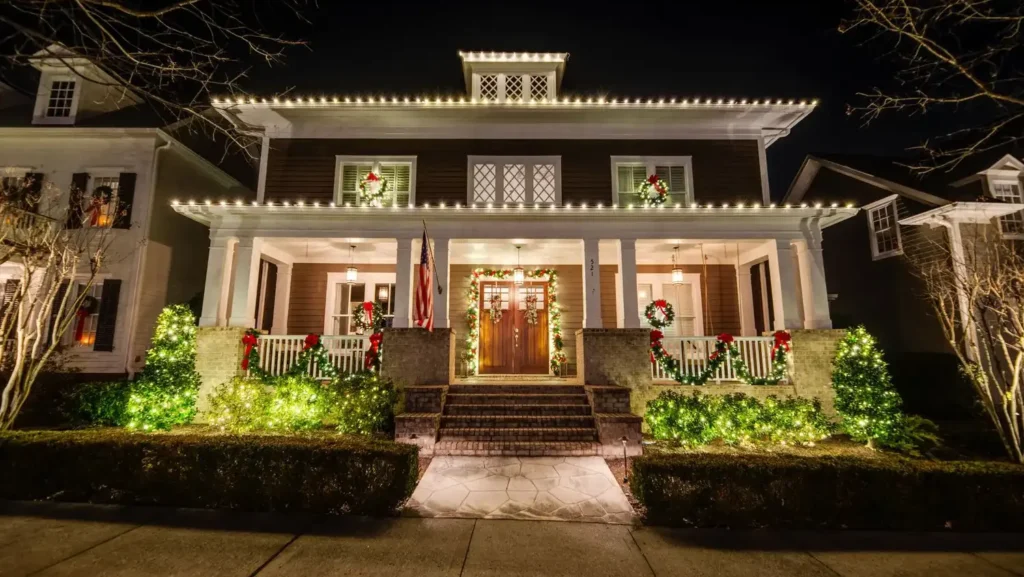
Most people plan Christmas lights from the roof down. Rooflines first, then whatever is left over goes on the trees. On a lot of Nashville properties that order is backwards. If the house sits back off the street, the roofline reads as one thin bright line from the road, and the trees are what people actually see.
Tree lighting is also where do it yourself work goes wrong most often. A roofline is a fixed edge with one correct answer. A tree has to look right from the street, from the driveway, and from the front window.
Wrapping versus canopy: pick one on purpose
There are two real ways to light a tree. Mixing them by accident across a yard is what makes a property look unplanned even when every strand is working.
Wrapping
Wrapping means spiraling strands up the trunk and out along the major limbs. Done properly, the structure of the tree becomes the decoration. You see the taper of the trunk, where the limbs split, how the branching thins out toward the ends. It works best on trees with architecture you can read from thirty feet away: crepe myrtles, Japanese maples, young oaks, anything with a trunk that has a shape worth showing.
Wrapping is slow. That is the honest part. One mature crepe myrtle with four or five trunks can take longer than a garage roofline. The time goes into the detail, not the difficulty.
Canopy lighting
Canopy work puts the light up in the crown instead of on the trunk. Strands are worked through the upper limbs so the mass of the tree glows from the inside out. You are not showing structure here, you are showing volume.
This is the answer for big shade trees. A sixty foot water oak cannot be sensibly wrapped. Lighting the bottom fifteen feet of a tree that tall just calls attention to the forty five feet that are dark. Canopy on a tree that size means a lift and a crew, not a ladder and a Saturday.
Spacing is most of the result
The difference between a tree that looks professionally lit and one that looks decorated is spacing. Not bulb count, not color temperature. Spacing.
- Consistency beats density. Wraps three or four inches apart the whole way up read as a clean line of light. Wraps that start tight at the base and loosen as the installer gets tired read as a mistake, and it is obvious from the curb.
- Tighter looks more deliberate. A two inch wrap on a small ornamental tree looks solid and intentional. An eight inch wrap on the same tree looks like an extension cord.
- Do not wrap what you cannot finish. A limb wrapped halfway and abandoned is worse than a limb left dark. Decide which limbs are in the design, then take them all the way out.
- Never cinch a strand. Lights should sit against bark, not bite into it. Trees put on wood every year. A wrap pulled tight in November is tighter next November if it never comes off.
That last point is the real argument for taking lights down instead of leaving them up all year. Red Nose Lites does Christmas and holiday lighting only, and takedown after the holidays is part of every job, so the strands come off the tree rather than growing into it. Off season storage is included too, so the wire is not sitting in your garage for eleven months.
Trees are what carry a deep lot
This matters most on the properties where the house is not close to the road. Think the long setbacks and long driveways you get around Belle Meade, Forest Hills, Oak Hill and out toward College Grove, or the older lots in Franklin where the tree line got there first.
From a hundred and fifty feet away, a lit roofline is a horizontal stripe with no depth. Trees are what give the front of a property layers: something lit near the road, something halfway up the drive, then the house behind it. Drive past two identical homes, one with a perfect roofline and one with three well wrapped trees staged down the driveway, and the second one looks like more was spent even if it was not.
The practical version: if the budget only covers part of the property and the house sits well back, put it in the trees near the street before the second story gable nobody can resolve from the road. Our process page covers how a design gets scoped, and the Belle Meade page covers the deeper lots.
Which Nashville trees take light well
- Crepe myrtle. The best tree in Middle Tennessee for wrapping, and it is not close. Multiple smooth trunks, open structure, no leaves in December, and most are short enough to work from the ground or a short ladder.
- Maples and young oaks. Good candidates while the trunk and main limbs are still reachable. Once tall, they become canopy trees.
- Dogwoods and Japanese maples. Small, layered, and excellent wrapped tightly. Thin branches, so the wrap has to be neat or it looks messy.
- Southern magnolia. Dense evergreen leaves swallow light, so anything inside the canopy mostly disappears. Wrapping the trunk works, lighting the interior does not.
- Bradford pear. Brittle wood and weak branch unions. Not a tree to climb around in with an armful of strands.
- Pines and cedars. Needles hide the strand and diffuse the light. It can look good as a soft mass but will never give crisp lines.
Where do it yourself is genuinely fine
Two crepe myrtles flanking the front walk, a pair of small ornamentals, the shrubs by the porch. All of it is reachable, low risk, and a reasonable weekend. If that is the whole plan, do it yourself and spend the money elsewhere.
Where it stops being worth it: anything needing a ladder taller than you are comfortable on, any canopy work, and any property with more than a handful of trees in the design. The problem with a dozen trees is not skill, it is hours. The fourth tree takes as long as the first.
What Nashville weather does to tree lights
Trees move. Rooflines do not. Wind works a loose wrap looser all season, and a strand that was neat on install day can be sagging by the third week if it was not secured properly.
Then there is ice. Middle Tennessee gets freeze and thaw cycles rather than one long hard freeze, and that is harder on a wrapped limb than steady cold. Water gets in, freezes, expands, and lifts anything resting loosely. Clearing wet leaf litter from the base of a trunk wrap is worth doing, because that is where connections sit.
This is why every install here uses custom cut commercial grade LED strands rather than retail sets, and why in season maintenance and a 24 hour service guarantee are part of the job. Something will go out in a December wind. It gets fixed quickly rather than staying dark until January.
Getting a number for your trees
You can get a price on the phone. Call (615) 595-9686, describe the trees, roughly how tall they are, and whether you want them wrapped or lit in the canopy, and you can get a quote on that call. A site visit is available if you want one, or if the property is large or unusual, but it is an option rather than a requirement.
There is also a quote form if you would rather write it out. Either way there are no contracts, and design, installation by insured crews, in season maintenance, takedown and storage are included rather than priced as add ons. Red Nose Lites is family owned in Nashville and has been doing this since 2006.
Want your home to look like this?
Red Nose Lites designs, installs, maintains and takes down custom Christmas lighting across Nashville and Middle Tennessee. No ladders, no tangled strands, no storage.
Get a Free Quote