
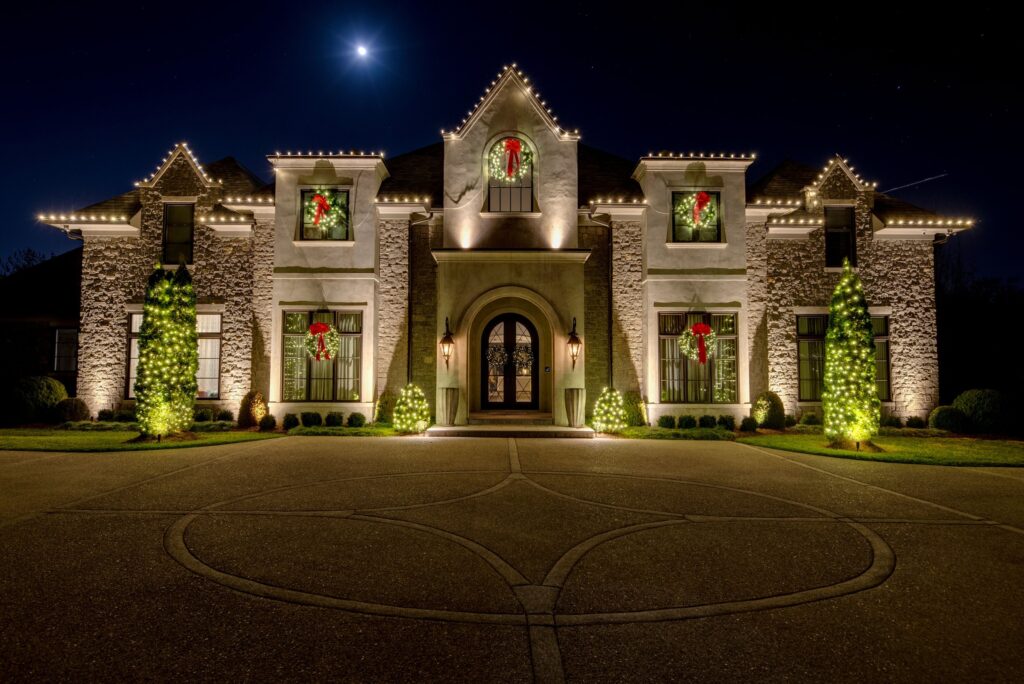
Every season the same question stalls people before anything else gets decided: classic white or multicolor. Homeowners sit on it for weeks. It is worth ten minutes of real thought, then it is worth moving on, because the palette matters less than where the lights sit on the house.
Still, the two do not behave the same way once they are up on a roofline. Here is how each one reads from the street, and how to match it to the exterior you already own.
The one difference that drives everything else
A white roofline reads as a line. Your eye connects the bulbs and follows the shape of the house: the ridge, the gable, the drop over the porch.
Multicolor reads as a sequence of points. Your eye stops on each bulb and steps along the run. It does not trace the architecture in the same way.
That is the whole thing. If your house has shape worth showing, meaning gables, dormers, a porch with columns, white traces it and hands it back to you at night. If your front elevation is flat, white will faithfully outline something flat. Multicolor gives that same house rhythm instead.
How classic white reads from the street
Warm white and cool white are different products
People say “white” and mean two very different looks.
- Warm white leans amber, closer to candlelight. It sits comfortably next to brick, stone and wood, and it matches the light coming out of your windows.
- Cool white has a blue edge, closer to moonlight. It looks crisp against white trim, gray siding and black windows. Against warm red brick it can read cold, almost like a parking lot.
Whichever you pick, pick one. Two different whites on the same elevation look like a repair, not a decision, and it usually happens when a box store strand gets added to an existing run. Say out loud which white you want, and ask that every run on the house match it.
Exteriors that white flatters
- Red brick, which is most of the older housing stock around Nashville. Warm white against red brick is close to a default for a reason.
- Limestone and stacked stone, where you want the texture to stay visible instead of competing with color.
- Dark painted brick and dark siding, where a bright line has maximum contrast to work with.
- Houses with real rooflines: multiple gables, dormers, a steep pitch. White does the most work here.
- Anything you want to look restrained. If your goal is that the house looks finished rather than decorated, white gets there.
How multicolor reads from the street
Two practical things about color that nobody mentions until the lights are on.
First, colored bulbs put out less apparent light than white ones. Same strand, same spacing, the multicolor version looks softer from a distance. That is not a defect and it is not a quality problem. It means multicolor rewards a shorter viewing distance. A house sitting close to the sidewalk gets the full effect. A house set well back behind a deep lawn gives up some of it.
Second, multicolor needs pattern discipline. A repeating sequence reads as a design. Random color placement reads as clutter, and it reads that way from further off than you would think, because at distance your eye picks up the rhythm, not the bulbs. Ask what the repeat will be before the crew starts.
Exteriors that multicolor flatters
- White, cream and light painted siding, where colored bulbs have a neutral background to pop against.
- Single story and ranch rooflines, where a plain horizontal run needs the interest.
- Cottages, bungalows and Tudor fronts, where a little bit of storybook is already the point.
- Houses close to the street with sidewalk traffic, in the older walkable pockets like 12 South and Sylvan Park, where people actually see the bulbs rather than the glow.
- Houses with kids in them. Not a design argument, and the real reason plenty of these jobs go multicolor. Good enough reason.
Setback changes the answer more than taste does
Before you decide anything, walk out to where your house is actually seen from and stand there.
On the deep lots you find in Forest Hills and Oak Hill, the viewer is far back and often moving. Detail disappears at that range. White holds its shape, and the roofline still draws cleanly from the road. On tighter lots where the front door is close to the sidewalk, every bulb is legible and color earns its keep.
Mixing white and multicolor without making a mess
Mixing works. Alternating does not.
The rule that holds up: one palette per plane. Give the roofline one palette and let a second element carry the other. White along the roof with color wrapped on the porch posts or the tree by the drive is legible and intentional. White and color alternating along the same gutter run looks like a compromise between two people who never settled it. Front in one palette and the backyard in the other works fine too, because nobody sees both at once.
When switching is not worth paying for
A few honest calls.
- If white is already up and you like it, do not swap it because a neighbor went multicolor. That is money spent on a lateral move.
- If the job is one short run over the garage, the palette barely registers. You would get far more out of the same budget by covering more of the house, or adding the peak, than by changing color.
- If you cannot decide, go warm white this year. It is the harder look to regret, and you will know a lot more about what you want after one season of looking at your own house lit up.
- Small runs of store bought lights on a porch railing are genuinely fine to do yourself. Save the professional work for anything at height, anything on a steep pitch, and anything on a second story.
What does not change with the palette
The install is the same job either way. Every Red Nose Lites install includes the design, custom cut commercial grade LED strands sized to your rooflines, installation by insured crews, in season maintenance, takedown after the holidays and off season storage. We store the lights, so nothing goes in your attic in January.
The attachment method does not change either. Clips are sized to your roof edge or gutter lip. No staples, no nails and no screws into fascia, trim or shingles, on a white job or a multicolor one. There is a 24 hour service guarantee during the season, and there are no contracts or long term commitments. If you want the sequence laid out step by step, it is on the how it works page, and the scope of a full home install is covered under residential installation.
Decide, then get a price
You do not need to have the palette settled before you call. Most people work it out during the conversation, once someone asks what the house is made of and how far back it sits.
Call (615) 595-9686, describe the home and what you want lit, and you can get a price on that call. If the property is large or unusual, or you simply want someone to look at it in person, a site visit is available. It is an option, not a step you have to clear first. You can also start from the quote form and we will call you back.
Red Nose Lites has been doing this in Nashville since 2006, with 20 plus years of experience behind the crews. White or multicolor, the goal is the same: it goes up clean, it stays lit, and it comes down without you touching a ladder.
Want your home to look like this?
Red Nose Lites designs, installs, maintains and takes down custom Christmas lighting across Nashville and Middle Tennessee. No ladders, no tangled strands, no storage.
Get a Free Quote