
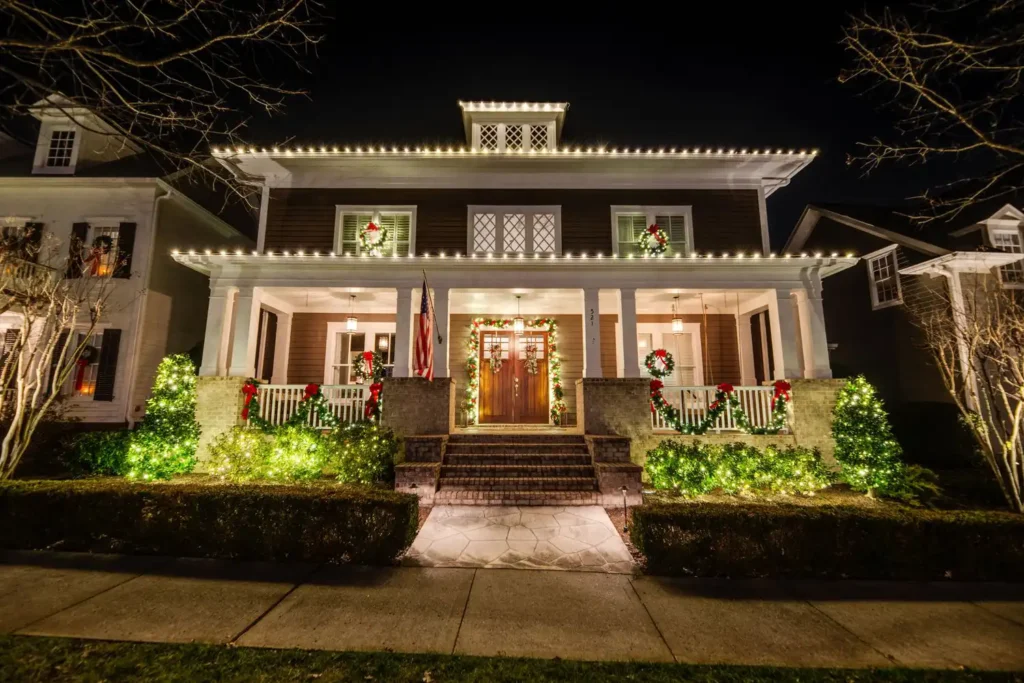
The lights go up in November. After that, the only part of the display you ever touch is the switch. Getting that right is worth five minutes of thought, and for most homes it costs very little.
Here is how a display actually gets turned on and off, what a smart plug does and does not solve, and how to work out what yours costs to run.
What a christmas light timer actually has to do
The job is narrow. Switch the display on around dusk, run it for a set number of hours, switch it off, repeat for roughly six weeks, and survive rain and freezing nights while doing it. That is the whole specification. Everything a control does beyond that is convenience, not function.
Two things make it harder than it sounds. Outdoor outlets in Middle Tennessee spend December wet, and sunset moves. Both of those matter more than anything printed on the box.
The three ways to switch a display
A plain outdoor timer
A mechanical or digital timer in a weather rated enclosure plugs into the outlet, and the lights plug into it. You set an on time and an off time and walk away. No app, no account, no Wi Fi. For a single family home with one circuit feeding the display, this is usually the right answer and we will say so.
The drawback is that it runs on clock time, not daylight. Set it in November and by January it is firing at the wrong moment. That is a two minute adjustment once or twice a season, or something you decide not to care about.
A photocell
A photocell switches the circuit on when ambient light drops. It tracks dusk by itself, which solves the drift problem, but on its own it will run the display straight through until dawn. Most people pair one with a timer that cuts power after a set number of hours, so the roofline is not burning at 3am for an empty street.
Photocells get fooled by streetlights, porch lights and headlights from a close road. Where you mount the sensor decides whether it works at all.
A smart plug or app control
An outdoor rated smart plug puts the display on your phone. The useful part is not the on and off button, which you will use twice and then forget. It is scheduling relative to sunset. Set it to come on at sunset and off at eleven, and it corrects itself every night all season.
The trade is that it depends on your Wi Fi reaching an outdoor outlet, and on somebody’s servers staying up in December. Both fail sometimes. Buy one that keeps running its schedule when the internet drops, because plenty do not.
The sunset problem, specifically
The earliest sunsets of the year land in the first half of December, and by early January dusk is noticeably later than it was on the day you set the timer. A fixed clock schedule that looked right when the display went up ends up firing well into the dark, or before it.
You either nudge a plain timer once or twice across the season, or you let a sunset based schedule handle it. Neither is wrong. One just costs more.
When a smart control is worth the money
- More than one circuit. Roofline on one outlet, trees and walkway lighting on another. With separate dumb timers they drift apart and you end up with half a display lit.
- You travel over the holidays. Confirming from elsewhere that the display is actually on has real value, especially if the house is meant to look occupied.
- A property you cannot see from the house. On a long drive or a wooded lot you often have no idea whether the front fired at all.
- Commercial sites. A storefront or office park usually needs lighting on before staff arrive and long after they leave, and those hours shift over the holidays. Our commercial installation page covers how those jobs run.
When it is not worth it
If you have one outlet feeding a front roofline, a basic outdoor dial timer does everything a smart plug would do here, for a lot less. Adding an app, an account and a Wi Fi dependency to a job a dial handles is not an upgrade. It is one more thing that can be down the evening you have people over.
The same goes for a smart plug you end up switching by hand. If you open an app every night, you have bought a remote control, not a timer, and you will stop using it by the second week of December.
Weather is the real failure point
Nashville rarely delivers a hard freeze in December so much as weeks of damp with a cold snap dropped in. That is harder on outdoor electrics than a clean freeze.
- Use an in use weatherproof outlet cover, the kind that closes over the plug while it is plugged in, not a flat flip lid propped open.
- Keep the timer and every connection up off the ground. A puddle across a joint will trip a GFCI outlet all evening.
- Leave a drip loop in the cord so water runs off the low point instead of into the connection.
- Check the enclosure is rated for outdoor use. An indoor timer inside a plastic bag is not an outdoor timer.
A tripped GFCI looks exactly like a lighting fault from the driveway. Before you assume a strand has failed, press reset on the outlet and check the timer is actually calling for power.
What the display costs to run
Do not take anyone’s word on this, including ours. It depends on your display and your rate, and you can work it out in about a minute.
Find the wattage on the strand tag. Multiply by the number of strands, then by the hours you run per night, then divide by 1000. That is kilowatt hours per night. Multiply by the rate on your electric bill and by the number of nights you run the display, and you have your season.
Two things fall out of that. Hours are the biggest lever you control: dusk to eleven instead of dusk to dawn is roughly half the bill, and nobody is looking at your roofline at 4am. And commercial grade LED strands draw a small fraction of what old incandescent sets pulled, which is why a whole house of LED can cost less to run than a couple of runs of the lights you had twenty years ago.
How this fits with a professional install
Every install includes design, custom cut commercial grade LED strands, installation by insured crews, in season maintenance, takedown after the holidays and off season storage. Switching is the part that stays in your hands all season, so raise it when we talk about the design. Tell us where your outlets are and how you want the display run.
If a section does go dark and it turns out not to be the timer or the outlet, we run a 24 hour service guarantee during the season. You are not waiting until January for a fix. The how it works page walks through the full process.
Getting a price
You can call (615) 595-9686 and get a price on that call. Describe the house, tell us what you want lit, and we will talk numbers. A site visit is available if your property is large or unusual, or if you just want someone to look first, but it is not a requirement. You can also send us the details and we will come back to you.
We light homes and businesses across Nashville, Brentwood, Franklin, Hendersonville and the wider Middle Tennessee area.
Want your home to look like this?
Red Nose Lites designs, installs, maintains and takes down custom Christmas lighting across Nashville and Middle Tennessee. No ladders, no tangled strands, no storage.
Get a Free Quote