Nashville winters do not commit to anything. A single December week here can open with freezing rain and close at 60 degrees and muggy. That swing, more than the cold itself, is what takes Christmas light displays down. A display that would run all season in Minnesota can fail in Middle Tennessee, because our weather never lets the system sit still long enough to stay sealed.
If you want lights that stay lit from Thanksgiving into January, weatherproofing is not a product you buy. There is no spray that fixes it. It is a set of decisions about strands, connections, attachment and drainage. Here is what actually fails, in what order, and what is honestly not worth paying for.
What Tennessee weather does to a light display
The freeze and thaw cycle is the real enemy
Water works its way into a plug connection on a warm wet afternoon. Overnight the temperature drops and that trapped water freezes and expands. It pushes the two halves of the connection apart by a fraction of a millimeter. Nothing looks broken. The next warm day, more water gets in through the gap the ice just made. Do that eight or ten times across December and a connection that was clean on installation day is corroded green and dead.
This is why a display can look perfect for three weeks and then lose an entire roofline overnight. The failure was building the whole time. You just could not see it.
Wind loads that ground level decor never feels
Ridgelines, gable peaks and second story eaves catch wind that the wreath on your front door will never experience. Wind rarely snaps a strand outright. What it does is work a connection loose over days, or drag a run sideways until the clips at one end are carrying the load for the whole line. Then one gust finishes it.
Ice weight in the wrong place
Freezing rain coats a strand along its entire length and adds weight evenly. That is usually survivable. The problem is a gutter that is still full of oak leaves from November. Now you have standing water, ice, and a light line clipped to a gutter lip that is already carrying more than it should. Clear your gutters before anything goes up. That one hour of work prevents more failures than any product on a shelf.
What fails first, roughly in order
- Connections at ground level. Any plug sitting in mulch, grass or a flower bed is sitting in standing water every time it rains. This is the single most common point of failure.
- Cheap strands with thin insulation. Big box seasonal strands are built to a price. The wire jacket cracks in cold, and once it cracks, water is inside the run itself, not just the plug.
- Whatever is holding the lights to the house. Undersized or wrong shaped clips let go. Staples and nails are worse for a different reason, covered below.
- Timers and cheap smart plugs. Many are rated for a covered porch, not for weather. They fail in a way that looks like the lights died when the lights are fine.
- The GFCI outlet. This one is not really a failure. A GFCI that trips in a storm is doing its job and telling you water reached something it should not have.
How to weatherproof christmas lights at the connection
Almost all of weatherproofing is connection discipline. Four things matter:
- Get every connection off the ground. Zip tie it to a downspout bracket, a rail, a stake, anything that holds it a few inches up and out of the wet. Never coil a joined connection in a gutter.
- Use a drip loop. Let the cord hang down below the connection before it goes back up. Water runs down the cord, reaches the bottom of the loop and drips off instead of running into the plug. It costs nothing and it works.
- Point connections down or sideways, never up. An upward facing socket is a cup.
- Use outdoor rated cords and a cover box for the outlet. An indoor extension cord run out a window is the version of this that ends badly.
One thing not to do: do not wrap connections tightly in electrical tape. It feels like sealing. What it actually does is trap the water that gets in anyway and hold it against the metal contacts all season. A vented cover or a drip loop beats tape every time.
Attachment: what holds and what damages the house
Clips sized to the roof edge or the gutter lip are the correct answer. A clip that matches the profile of what it grips spreads the load, comes off cleanly in January, and leaves nothing behind.
Staples, nails and screws driven into fascia, trim or shingles are never worth it. They create a hole in a surface that is supposed to shed water, in the exact season that surface is under the most stress. That hole is still there in July. On our installs, nothing gets stapled, nailed or screwed into fascia, trim or shingles, ever. Clips only.
Where doing it yourself is completely fine
We are not going to pretend every house needs a crew. Shrubs, porch railings, a wrapped column, a single story front with a low pitch and safe ladder footing: that is a good Saturday. Buy decent strands, use the drip loops, keep your connections dry, and you will be fine.
Where it changes is height and pitch. Second story eaves, steep roofs, and anything that means standing on a ladder on frozen ground in December is a different job. The lights are the easy part. Getting to them safely twice, once to install and once to take down, is the actual work.
What is not worth paying for
Skip anything sold as a weatherproofing spray or sealant for light strands. Skip decorative covers that hold water. And be skeptical of any strand marketed as weatherproof without a stated outdoor rating, because the word by itself means nothing.
What is worth it is the strand quality and the design. Custom cut commercial grade LED strands mean each run is made to the length of that specific roof edge, so there is no leftover slack looping around and no unnecessary joint in the middle of a run. Fewer connections is fewer failure points. That is the whole trick.
How we handle it
Red Nose Lites has been doing this in Nashville since 2006, so we have watched 20 plus years of Tennessee Decembers do exactly what is described above. Every install includes design, custom cut commercial grade LED strands, installation by insured crews, in season maintenance, takedown after the holidays, and off season storage. We store the lights, you do not.
The maintenance part is the one that matters for weather. When a section goes out after an ice night, you call and we come fix it. We hold a 24 hour service guarantee during the season, and there are no contracts or long term commitments attached to any of it. You can read the full process on how it works, or look at what is covered under residential installation.
We cover Nashville and the surrounding area, including Brentwood, Franklin, Hendersonville, Gallatin, Belle Meade, Green Hills and Forest Hills.
If you want a price, call (615) 595-9686 and describe your home and what you want lit. We quote over the phone on that call. If your property is large or unusual, or you would simply rather we came out and looked, we can do that too, but it is an option and not a requirement. You can also start with the form at get a quote.
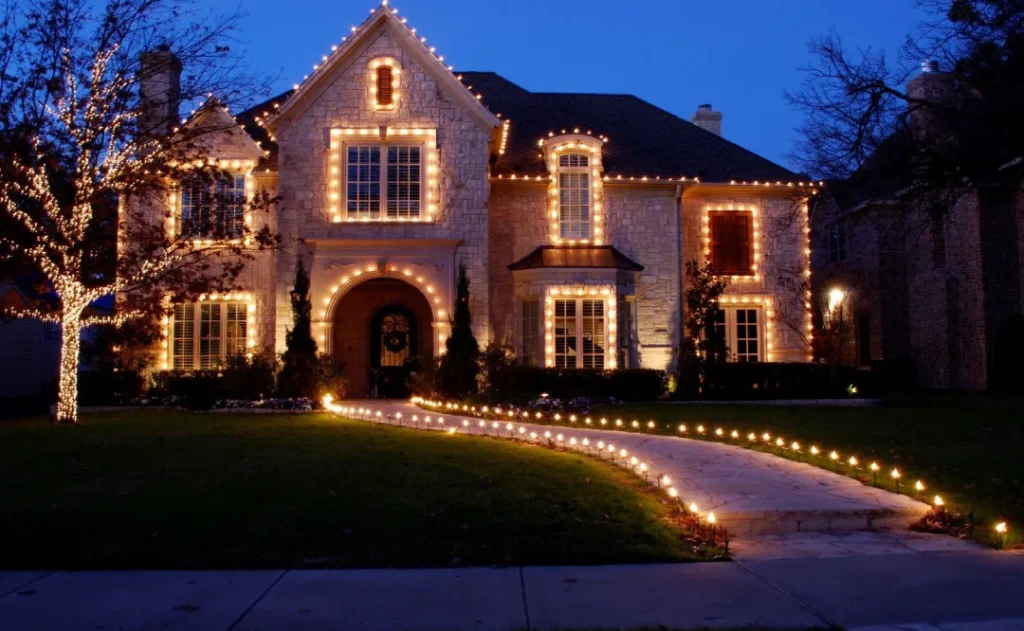
Want your home to look like this?
Red Nose Lites designs, installs, maintains and takes down custom Christmas lighting across Nashville and Middle Tennessee. No ladders, no tangled strands, no storage.
Get a Free Quote