A storefront has a few seconds to earn attention. Someone driving past, or walking by on a cold December evening, decides almost instantly whether a shop looks open, warm and worth a stop. Storefront holiday lighting is one of the simplest ways to change that decision. It is also easy to get wrong, either by spending on the parts nobody sees or by putting up something that looks tired by the second week of December.
This guide covers what actually works on retail frontages: the facade, the windows, the entrance, and the practical details that decide whether the display holds up through the season.
Start with what people see from the street
Stand across the road from your shop after dark and look at it. Then drive past it. That is the view that matters, not the view from your own doorway.
Most shops find the same three things:
- The roofline or parapet is what defines the building at a distance. A clean line of light along it makes the whole storefront read as one shape.
- The windows are what people look at once they are close. A dark window at 6pm makes a shop look closed, even when it is not.
- The entrance is where people decide to come in. It should be the brightest, clearest point on the frontage.
If your budget only stretches to one of these, pick the one that fixes your biggest problem. A shop set back from a busy road needs the outline. A shop on a walkable street with steady foot traffic gets more from lit windows and a well framed door.
Facade treatments
Outlining the building
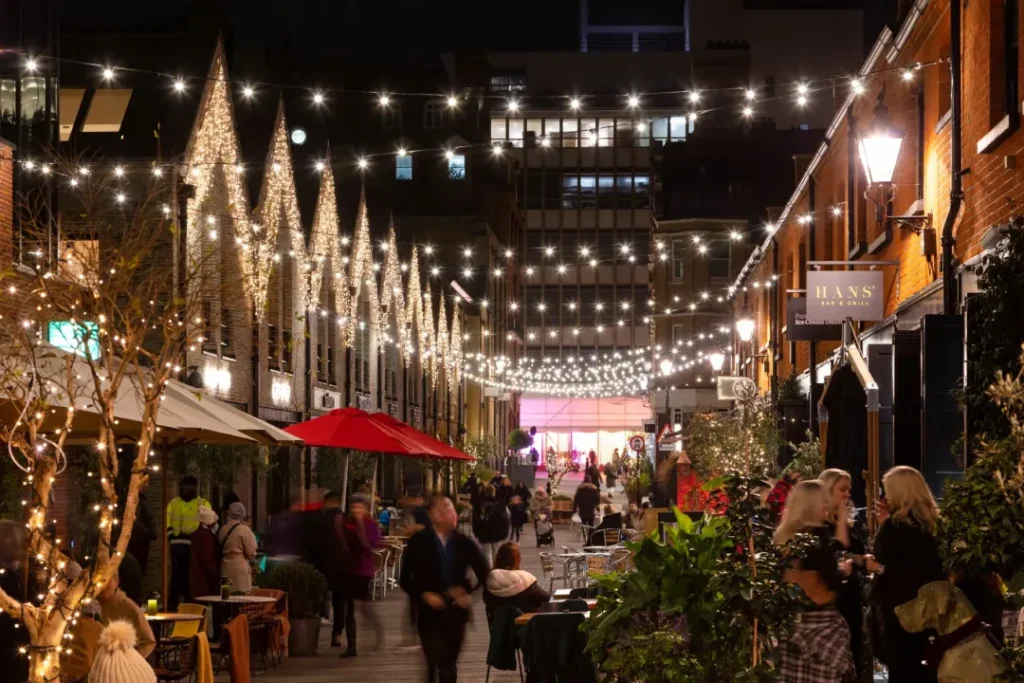
A single run of lights along the top edge of the facade is the backbone of most storefront displays. On a flat roof commercial building that usually means the parapet cap or the edge of the canopy. On an older brick storefront with a cornice, it means following the cornice line.
The key is a straight, even line. Sagging runs and uneven bulb spacing look cheap from the street, and they look worse on a commercial building because the architecture is usually all straight lines. This is why we use custom cut commercial grade LED strands, cut to the length of each run, rather than stock strands with a coil of spare wire tucked behind a downspout.
Protecting the building
Many retail tenants lease their space, and a landlord will not thank you for holes in the facade. We attach with clips sized to the roof edge or gutter lip. We never put staples, nails or screws into fascia, trim or shingles. When the lights come down, the building looks the way it did before they went up.
If you lease, check your lease anyway. Some landlords and shopping centers have rules about what tenants can mount on the exterior and when.
Columns, awnings and canopies
Columns and posts at the entrance are good places to add light because they sit at eye level. Awnings are trickier. Fabric awnings do not give lights much to hold on to, and anything draped across one tends to sag by midseason. A lit line along the rigid frame or the front edge usually looks better than trying to cover the fabric itself.
Window treatments
Windows do two jobs at once. From outside they frame the display. From inside they are the backdrop your customers see while they shop.
- Frame the glass. A run of light around the window perimeter makes the window read as a bright rectangle from down the street. It works whether the display behind it is elaborate or simple.
- Keep the product visible. Lights that cover the glass compete with what you are selling. If people cannot see the merchandise, the lighting is working against you.
- Think about glare. Bright lights pressed against glass bounce back at people looking in. Keeping lighting at the edges avoids most of that.
- Match the color temperature. Warm white outside and cold white inside can look mismatched through the glass. Pick one direction and stay with it.
A word on DIY: the display inside the window is often a job a shop owner can do well. It sits at ground level, and you know your merchandise better than anyone. The roofline and anything that needs a ladder is where hiring a crew makes more sense.
The entrance
The door is where lighting turns into sales. Framing the entrance with light, and adding greenery or lit accents on either side, gives people a clear target. It also answers the question every passerby has on a dark winter evening: is this place open?
Keep walkways clear. Cords across a sidewalk or a doorstep are a trip hazard for your customers, and a fall on your property is your problem. Every power run should sit out of the walking path.
What is not worth paying for
Not every idea earns its cost on a storefront. A few that usually do not:
- Lighting the back or sides of the building when nobody walks or drives there. Spend on the frontage people actually see.
- Lots of colors and effects. Chasing, flashing and rainbow schemes can make a shop look busy rather than inviting. Retail frontages generally read better with one clean color scheme.
- A huge display on a small frontage. A narrow shop in a row of storefronts does not need to outshine the whole block. A well lit outline, window and door is often enough.
- Anything that hides your sign. If your name is harder to read in December, the lights are costing you.
Timing matters more for shops than homes
For a homeowner, lights going up a week late is a small annoyance. For a retailer, the lights are there to support the busiest selling weeks of the year. A display that goes up after the season has started misses part of what it is for.
Book early. Commercial jobs take planning, and the calendar fills as the season approaches. It also helps to know what happens after the holidays. Takedown is included with every install we do, so the building is back to normal without your staff spending a morning on ladders.
Keeping it working all season
A storefront display with a dark section looks worse than no display at all, because it looks neglected. Weather is the usual culprit in Middle Tennessee. Wind, freezing rain and hard cold snaps all test a display between November and January.
Every Red Nose Lites install includes in season maintenance and a 24 hour service guarantee during the season. If a section goes out, it gets fixed quickly rather than sitting dark through a weekend of shoppers. After the holidays we take everything down and store it, so you are not finding room for boxes of lights in the stockroom.
There are no contracts and no long term commitments. If the display worked for your shop, you can do it again next year. If it did not, you are not locked in.
Getting a quote
You do not need to wait for anyone to visit. Call us on (615) 595-9686, describe your storefront and what you want lit, and we can give you a price on that call. If the property is large or unusual, or you would simply rather we came out and looked, a site visit is available. You can also use the quote form.
Red Nose Lites is a family owned company that has been installing Christmas lights around Nashville since 2006. To see how a job runs from first call to takedown, read how it works, or look at our commercial installation page. We work with businesses across the area, including Franklin, 12 South and Green Hills.
Want your home to look like this?
Red Nose Lites designs, installs, maintains and takes down custom Christmas lighting across Nashville and Middle Tennessee. No ladders, no tangled strands, no storage.
Get a Free Quote