Every year someone asks whether their Christmas lights are going to wreck the electric bill. The honest answer depends almost entirely on one thing: whether the bulbs are LED or incandescent. The number of nights, the hours per night and your electric rate matter too, but the bulb type swings the result more than everything else combined.
Here is the math, with round example figures, so you can run it on your own house. Your rate is on your electric bill. A strand’s wattage is on the box or the tag near the plug.
The formula
Christmas lights energy cost comes down to four numbers multiplied together:
- Watts per bulb, from the box or tag.
- Number of bulbs on the house.
- Hours they run over the whole season.
- Your rate in cents per kilowatt hour.
Multiply watts by bulbs to get the total draw. Multiply that by the hours. Divide by 1,000 to turn watt hours into kilowatt hours. Then multiply by your rate. That is the whole calculation.
For the examples below we use 12 cents per kilowatt hour. That is a round number picked to make the math easy to follow, not a quote of any utility’s tariff. Swap in the rate from your own bill.
A typical season in hours
Most people turn the lights on sometime around Thanksgiving and take them down after New Year. Call it 40 nights. If the lights come on at dusk and go off at 11, that is about 6 hours a night. So a season is roughly 240 hours.
Leave them on all night and that number roughly doubles. Hours are the easiest number on the list to change.
Incandescent: the real numbers
The big classic bulbs people put along a roofline are C9s. An incandescent C9 is commonly rated around 7 watts. The smaller C7 is commonly around 5 watts. Check your own box, because ratings vary by brand.
Take a modest roofline with 200 incandescent C9 bulbs:
- 200 bulbs at 7 watts is 1,400 watts.
- 1,400 watts for 240 hours is 336,000 watt hours, or 336 kilowatt hours.
- 336 kilowatt hours at 12 cents is about $40 for the season.
That is one roofline. Add shrubs, a couple of trees wrapped in incandescent minis and a garage outline in C9s, and it is easy to double or triple that figure.
The circuit problem nobody mentions
Look at that 1,400 watt number again. A standard 15 amp household circuit is 1,800 watts on paper, and the usual guidance for a load that runs for hours at a time is to keep it at 80 percent of that, which is 1,440 watts. So 200 incandescent C9s is about all one outdoor circuit should carry. Add a wreath or an inflatable on the same outlet and you start tripping the breaker on cold, wet nights.
This is often the real reason people give up on incandescent, not the bill. They run out of outlets before they run out of roofline.
LED: the same roofline
An LED C9 typically draws well under a watt. To keep the comparison fair and a little conservative, call it 1 watt per bulb.
- 200 bulbs at 1 watt is 200 watts.
- 200 watts for 240 hours is 48 kilowatt hours.
- 48 kilowatt hours at 12 cents is under $6 for the season.
Same house, same hours, same rate. Roughly $40 against roughly $6. And the LED roofline uses about a seventh of one circuit, so the rest of the display can share the same outlet.
Where switching to LED is not worth it
Here is the part most energy articles skip. For a small display, the savings are tiny.
A 100 light strand of incandescent minis is usually rated somewhere around 40 watts. Over 240 hours that is 9.6 kilowatt hours, a little over a dollar at our example rate. The LED version might save you most of that dollar. If you have three or four strands on a porch railing and they all still work, throwing them out to save a few dollars a year makes no sense. Use them until they fail, then replace them with LED.
Where the switch does pay is on the big runs: long rooflines, wrapped trees, anything with hundreds of C7 or C9 bulbs. That is where the watts add up and where the circuit limit starts to bite.
Other reasons LED wins on a Nashville house
Energy is the headline, but a few other things matter more once the lights are on a real roof through a Middle Tennessee winter.
- Heat. Incandescent bulbs get warm. LEDs stay close to cool to the touch. That matters next to dry wreaths, garland and pine straw in beds.
- Breakage. Incandescent C9s are glass. LED C9s are usually plastic and survive a drop off a ladder or a hard freeze much better.
- Rain and ice. Our winters swing between cold rain, a hard freeze and a 60 degree afternoon in the same week. Lighter loads and fewer daisy chained extension cords mean fewer nuisance trips after a storm.
Four ways to cut the running cost without changing bulbs
- Use a timer. Lights that run until sunrise cost roughly twice as much as lights that go off at 11. Nobody is looking at your roofline at 3 in the morning.
- Light what people see. The front roofline and the trees by the driveway do most of the work. The back gutter line that faces the woods does not.
- Measure before you buy. Strands that are too long get bunched up and stuffed behind a gutter, still drawing power. Cut to length runs avoid that.
- Do not stack old and new. One run of incandescent C9s mixed into an LED display can use more power than everything else on the house.
When DIY is fine
If your display is a porch, a few shrubs and a tree you can reach from the ground, do it yourself. Buy LED strands with the wattage printed on the box, put them on a timer and you will barely notice them on the bill.
Where hiring makes more sense is a two story roofline, a steep pitch, or a house where you want straight, even lines without spending two weekends on a ladder. That is the work we do.
How Red Nose Lites handles this
Red Nose Lites is a family owned company and has been installing Christmas lights around Nashville since 2006. Every install uses custom cut, commercial grade LED strands, so the energy question is mostly answered before you ask it. Lights are cut to your roofline rather than bunched up, and they are attached with clips sized to your roof edge or gutter lip. No staples, nails or screws into fascia, trim or shingles.
Every install includes design, installation by insured crews, maintenance during the season, takedown after the holidays and off season storage. We store the lights, so there is no box of tangled strands in your garage. There is a 24 hour service guarantee during the season, and no contracts or long term commitments. You can read the full process on our how it works page, or see what a home install looks like on our residential installation page.
You can get a quote over the phone. Call (615) 595-9686, describe the house and what you want lit, and we can price it on that call. If the property is large or unusual, or you would just rather have someone walk it with you, a site visit is available, but it is not required. You can also use the quote form.
We work across Nashville, Brentwood, Franklin, Hendersonville and the surrounding neighborhoods.
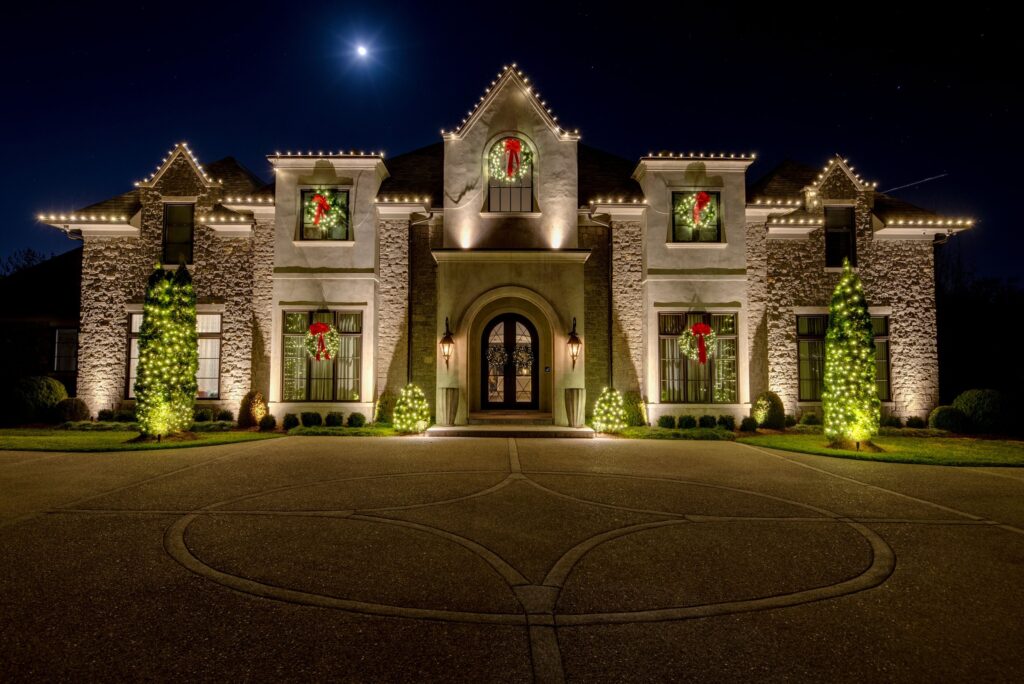
Want your home to look like this?
Red Nose Lites designs, installs, maintains and takes down custom Christmas lighting across Nashville and Middle Tennessee. No ladders, no tangled strands, no storage.
Get a Free Quote