Most people think about Christmas lights twice a year: the weekend they decide the house looks bare, and the weekend they finally take everything down. A bit of planning in between makes both of those easier. Here is how the season runs, month by month, whether you hire a crew or do it yourself.
September: decide what you actually want
September is the quiet month. The weather is still warm, nobody is on a ladder yet, and you have time to look at your house with a clear head.
Walk across the street at dusk and look back. Ask a few plain questions:
- Which rooflines can you see from the road? Those are the ones worth lighting. A back gable nobody sees is money and effort for nothing.
- Do you want warm white, multicolor, or a mix? Warm white suits brick and stone. Multicolor reads well on a simple ranch or a house with lots of kids around.
- Are there trees, shrubs or columns out front you want wrapped, or just the roof?
- Where are your outdoor outlets, and are they on a GFCI circuit that trips in the rain?
If you have an HOA, check its rules now. Some neighborhoods limit colors, dates or inflatable displays. Better to find out before anything is bought or booked.
October: get a quote and book
October is when to make the call on professional installation. Crews have a fixed number of working days between Halloween and Christmas, and every house on the schedule takes one of them. Booking early gives you more choice of dates. Booking in December means taking whatever is left.
Getting a price from Red Nose Lites does not need a site visit. Call (615) 595-9686, describe the house and what you want lit, and you can get a quote on that call. If you would rather someone come out, because the property is large or unusual or you just want to talk it through in person, a visit is available. It is an option, not a requirement. You can also use the quote form if the phone is not convenient.
Useful things to have ready when you call:
- Roughly how many stories the house is, and whether the roof is steep.
- Which sides of the house you want lit.
- Any trees, bushes or railings you want included.
- Your color preference.
There are no contracts and no long term commitments, so booking this year does not lock you into next year.
If you are doing it yourself
October is also the month for DIY prep. Pull last year’s lights out of the attic and plug every strand in on the floor before you climb anything. Dead strands are far easier to find at ground level. Check your ladder feet and your extension cords. Buy clips that fit your gutter or shingle edge. Do not use staples or nails. They damage fascia and trim, and water gets in through the holes.
November: design and install
November is install month. Leaves are mostly down, which matters: a gutter full of wet leaves is a poor base for clips and a slippery place to work. Middle Tennessee Novembers are usually mild enough that crews can work most days, with rain being the usual interruption rather than cold.
A professional install with Red Nose Lites covers the whole job: design, custom cut commercial grade LED strands, installation by insured crews, maintenance during the season, takedown after the holidays and storage until next year. The strands are cut to the length of each roof run, so there are no bundles of spare wire hanging off a corner. Clips are sized to the roof edge or gutter lip. Nothing is stapled, nailed or screwed into the house. You can read more about the process on the how it works page.
Installing in November does not mean switching on in November. Many people wait until Thanksgiving weekend or just after. The lights sit on the roof, off, until you are ready.
DIY in November
If you are putting lights up yourself, pick a dry, calm day. Work with a second person holding the ladder. Start at the outlet end and work away from it, so you are never left short at the far corner. Test each run before you move to the next one. Single story ranch houses are a reasonable DIY job. Two story houses with steep pitches are where most people start to reconsider.
December: enjoy it, and fix what breaks
December is the payoff. Set a timer so the lights come on at dusk and go off at a sensible hour. It saves you remembering, and your neighbors will thank you.
Things will go wrong now and then. A strong wind pulls a run loose. A squirrel chews a wire. A heavy rain trips a GFCI outlet. With a professional install, this is covered: Red Nose Lites offers a 24 hour service guarantee during the season, so a dark section of roofline gets looked at rather than sitting dark until New Year.
If you did it yourself, keep a spare strand, a few extra bulbs and a handful of clips somewhere easy to reach. And if a GFCI keeps tripping every time it rains, check the connections sitting on the ground. A plug lying in a puddle is the usual cause. Lift it up off the ground and cover it.
January: take it down
January is the month nobody enjoys. It is colder, the days are short, and the roof can be wet or icy in the mornings. This is when a lot of DIY lights stay up far longer than planned.
With Red Nose Lites, takedown after the holidays is part of the install. The crew removes the lights, and the company stores them over the off season. You do not need attic space and you do not have to untangle anything next fall.
If you took them down yourself, do it on a dry day when the roof is clear of frost. Wind each strand around a piece of cardboard or a reel rather than into a ball. Label each one with where it went: front gutter, garage, porch rail. Next October, you will know exactly which strand goes where.
Is professional installation worth it?
Not always. If you have a single story house, a short roofline, a steady ladder and a free Saturday, doing it yourself is fine. Plenty of people enjoy it.
It becomes more worth paying for when:
- The house is two stories or more, or the roof is steep.
- You want a clean, even line along every edge rather than a few strands draped across the front.
- You do not have room to store lights, or you are tired of untangling them.
- You want someone to call if a section goes dark in mid December.
We have been doing this in Middle Tennessee since 2006, for houses in Nashville, Brentwood, Franklin, Hendersonville and the surrounding area. Details on homes are on the residential installation page, and businesses can see the commercial installation page.
The short version
- September: decide what you want lit and check HOA rules.
- October: call for a quote and book, or test your own lights.
- November: install on a dry day once the leaves are down.
- December: set a timer and fix problems quickly.
- January: take down, label, and store.
If you want a price, call (615) 595-9686 and describe the house. You can get a quote on the phone, or request one online.
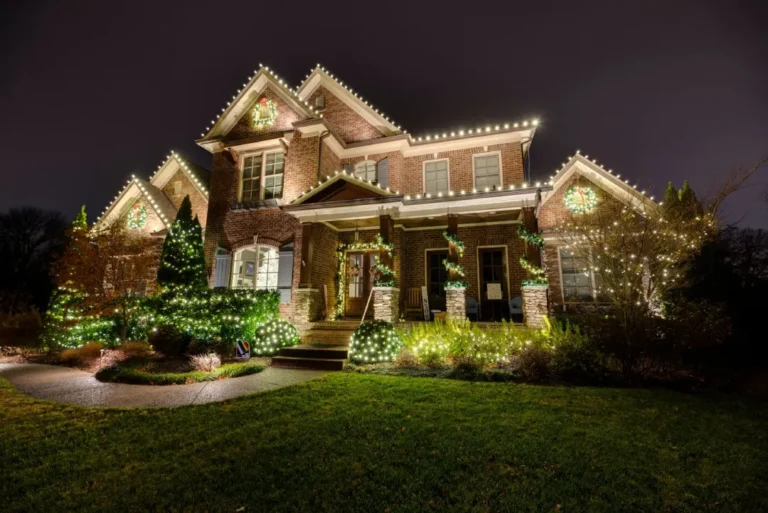
Want your home to look like this?
Red Nose Lites designs, installs, maintains and takes down custom Christmas lighting across Nashville and Middle Tennessee. No ladders, no tangled strands, no storage.
Get a Free Quote