
Most Christmas lights do not die on the roof. They die in a box in the garage sometime between January and November. A strand that worked fine on takedown day comes out eleven months later with a dead run in the middle, a cracked socket, or a plug that will not seat. It gets thrown out, replaced, and the same thing happens next year.
Storing Christmas lights properly is the cheapest thing you can do to make them last. It is also the job everybody rushes, because by the time the lights come down you are done thinking about Christmas.
If you are a Red Nose Lites customer you can skip all of this. Takedown and off season storage are included in every install, and the lights live with us, not in your attic. For everyone doing it themselves, here is what actually matters.
Take them down dry
This is the rule that saves the most strands, and it is the one most often broken. Middle Tennessee takedown weather is usually wet, grey and near freezing, so lights come off the gutter with water sitting in the sockets and plug ends.
Box them like that and the water sits against the copper contacts inside each socket for most of a year. What comes out in November is corrosion, and one corroded socket kills a whole run, because the run is wired in series.
So do this instead. Lay the strands out loose on a tarp in the garage and leave them alone for a day or two, with the plug ends stood up to drain. Once they feel dry to the hand, they are ready to pack. One day of patience beats any container you can buy.
Why a loose coil ruins wire
The instinct is to loop a strand around your hand and elbow, tie it off, and drop it in a tub. It feels tidy. It is the worst thing you can do to wire.
Light strand wire is not a single solid copper core. It is a bundle of fine strands twisted together, wrapped in thin PVC. When you wind it in a loose coil, the wire twists on its own axis with every loop. Drop that coil in a bin, stack two more bins on top, and the coil collapses into kinks. A kink concentrates all the bending at one tight point. The PVC there gets thin, the copper strands inside break a few at a time, and the strand goes dark with nothing visible to explain it.
The fix is to keep the wire under gentle, even tension on something round. That is the whole theory. Everything else is packaging.
Reels, and what you do not need to buy
Purpose made light reels are sold every year. They work. They are also not necessary, and the spend is hard to justify if you have a lot of strands. Cheaper things that work just as well:
- Cardboard from the recycling. Cut a rectangle roughly the size of a sheet of paper from a moving box, notch both short ends, and wind the strand around the long way. The notches hold the plug ends. One strand per piece.
- A length of pool noodle or pipe insulation. Wind the strand around the outside. The foam gives the wire a wide, forgiving radius and cushions the bulbs.
- An empty cord reel or hose reel. If you already own one, it is the best tool in the garage for this.
Whatever you wind on, wind wide. A large diameter is kinder to the wire than a small one. Do not pull tight. You want the strand held, not stretched.
Two things to avoid. Vacuum storage bags apply exactly the crushing force you are trying to prevent. Thin garbage bags tear and let strands tangle into one mass you end up cutting apart.
Label while you still remember
In January you know precisely which strand ran the front gutter and which one went around the porch. In November you know nothing. Labeling costs ten minutes and it is the difference between a two hour hang and a whole afternoon.
Masking tape and a marker on each reel is enough. Write where it went and how long it is:
- Front gutter, left of door
- Porch roof, 25 feet
- Garage eave, warm white
- Driveway tree wrap
Note the color temperature too if you run more than one. Warm white and cool white look nearly identical unlit in a box, and obviously different side by side on a roof. Sorting that out on a ladder in December is a bad time. If you cut strands to length for a specific run, write that measurement down. It is worth more than the strand.
Where you store them matters more than what you store them in
This is where most Nashville garages and attics let people down. The enemy is not cold. It is heat, and swings between heat and cold.
An uninsulated attic in a Tennessee July runs far hotter than the air outside, for weeks at a time. That heat dries out the sealant around LED sockets. Come back in November and the insulation is brittle and the sockets have opened up just enough to let moisture in the following season.
Crawlspaces are the other trap. They stay cooler, but Middle Tennessee crawlspaces hold humidity most of the year, and damp copper contacts is the same corrosion problem as packing wet.
Better options, in order: a closet inside the conditioned part of the house, under a bed, a basement that stays dry, then an interior garage wall away from the door. If the attic is genuinely your only choice, use a hard sided tote with a sealing lid, put a desiccant pack in it, and accept that the strands will age faster than they need to.
Test before you pack, not after
Plug each strand in before it goes on the reel. Thirty seconds each. If it is dead now, you know now, and you can replace it in the January clearance aisle instead of the second week of December.
Pack the clips with the strands they belong to, in a labeled bag inside the same tote. Clips sized to your roof edge or gutter lip are worth keeping, and they are the thing most likely to go missing between seasons. The right clip is what keeps anyone from reaching for staples, nails or screws, which have no business near fascia, trim or shingles.
Or stop doing this part entirely
Storage is the reason a lot of people quietly give up on doing their own lights after a few years. The strands never quite survive, the labels are gone, and November turns into a shopping trip.
Every Red Nose Lites install includes design, custom cut commercial grade LED strands, installation by insured crews, in season maintenance, takedown after the holidays, and off season storage. We store the lights. You do not find a box in the attic in July and wonder what is in it.
We have been doing this in Nashville since 2006, and we work across Nashville, Brentwood, Franklin, Hendersonville, Gallatin and the neighborhoods around them. You can see what a job involves on our how it works page or read more about residential installation.
If you want a price, call (615) 595-9686 and describe your home and what you want lit. We quote over the phone on that call. If your property is large or unusual, or you would just rather walk it with someone, we can come out, but it is your choice and not a requirement. You can also use the form on our get a quote page. No contracts, no long term commitments, and a 24 hour service guarantee once the season is running.
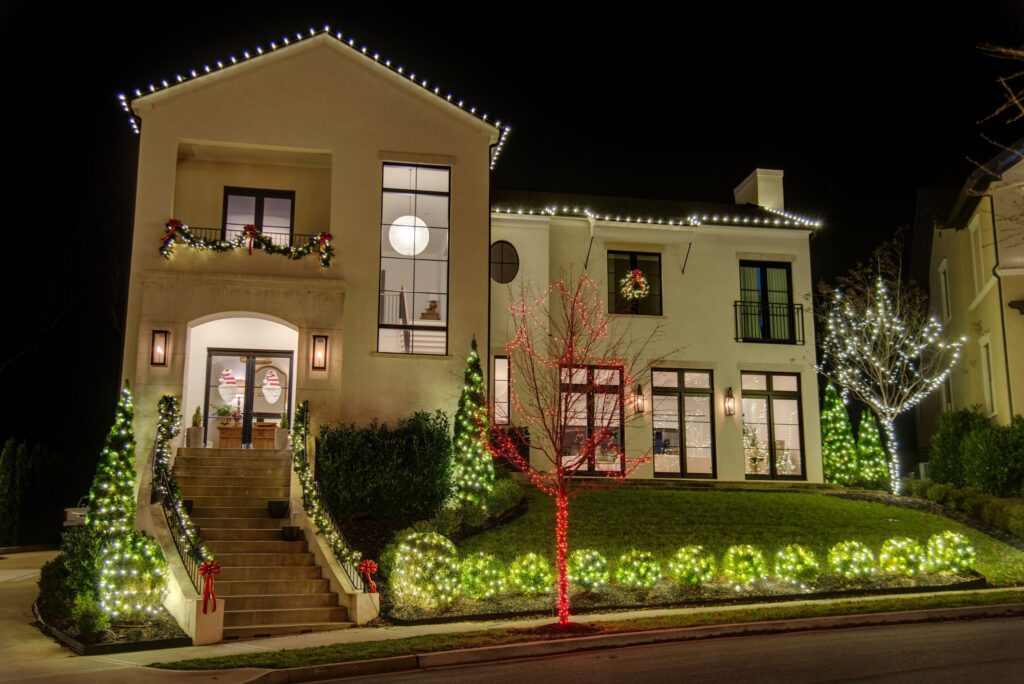
Want your home to look like this?
Red Nose Lites designs, installs, maintains and takes down custom Christmas lighting across Nashville and Middle Tennessee. No ladders, no tangled strands, no storage.
Get a Free Quote