Hanging Christmas lights is not complicated work. It is simple work done twenty feet off the ground, in December, by someone who does it once a year. That combination is what makes it risky, not the lights.
Red Nose Lites has been putting up holiday lighting around Nashville since 2006. Across 20 plus years of seasons, the pattern is consistent. Almost nothing goes wrong with the strands. Things go wrong with ladders, with circuits that were never meant to carry another load, and with people reaching one more time instead of climbing down and moving the ladder six feet.
The ladder is the dangerous part
Not the height. The setup. Most bad falls start at the bottom of the ladder.
Set the base before you think about the top
- Four to one. For every four feet of height to the contact point, the base sits one foot out from the wall. A ladder touching gutter at sixteen feet has its feet four feet out.
- Put the feet on something solid. Wet grass, mulch, pine straw and soft dirt all move. A scrap of plywood under the feet beats any gadget.
- Both rails even. If you have to twist the ladder to make it sit, the ground is wrong. Fix the ground.
- Extend past the edge. If you are stepping onto a roof, the ladder should stand three feet above the roof edge so you have something to hold.
- Stay off the gutter. A ladder loaded onto aluminum gutter deforms it, and the clips you just ran go with it. Use a standoff, or rest the rails on solid fascia or wall.
At the top
- Keep your belt buckle between the rails. The moment you reach past that line, your weight goes sideways and the feet want to slide.
- Do not stand on the top two rungs. Those are not rungs, that is the top of the ladder.
- Three points of contact at all times. That means lights go up in a bag over your shoulder, not in your free hand.
- Move the ladder more often than you want to. Every extra trip down is boring. Every extra reach is how this ends badly.
Circuits, cords, and the breaker that trips at six o’clock
LED strands draw very little current. That is the good news, and it is also how people get careless. The problem is rarely one run of lights. It is that run plus an inflatable, plus a projector, plus the garage freezer, all on one circuit.
- Know what shares the circuit before you plug in. Exterior receptacles are often tied to the garage.
- Every outdoor connection belongs on a GFCI. If your exterior outlet is not GFCI protected, that is a job for an electrician, not an adapter.
- Use cords rated for outdoor use, and use the shortest one that reaches. A long thin cord under load gets warm and drops voltage, and the far end of the display looks dim.
- Get the connections off the ground. Water pools, freezes, thaws, and sits in the joint. Hang it a few inches up on a hook.
- Respect the maximum run printed on the strand tag. Long end to end runs are allowed, but there is a limit, and exceeding it is a fire question, not a brightness question.
- Put the display on a timer.
The roof itself
Most Nashville rooflines are walkable in September and not in December. Asphalt shingles with morning frost behave like ice. Add wet leaves sitting in the valleys since November and it gets worse.
If the pitch is steep enough that you would not stand on it in tennis shoes in July, do not stand on it in December. Slate, metal, tile and cedar shake are not homeowner surfaces at all. Slate and tile crack under a knee, and that repair costs more than a season of lights.
How lights attach matters more than people think
This is the part that outlives the season. Red Nose Lites uses clips sized to the roof edge or the gutter lip. Never staples, never nails, never screws into fascia, trim or shingles.
A staple through a wire is an obvious problem. The quiet one is the nail hole in fascia or the screw through a shingle. It takes on water every rain for years, and you do not notice until there is rot in the trim or a stain on a ceiling. If you are doing this yourself, buy clips that match your actual roof edge and gutter profile, and expect to use more than you planned.
Custom cut strands are the other half of a clean install. Each run matches its stretch of roofline, with no leftover loop tucked behind a downspout. Cutting and re terminating a strand safely takes the right connectors and technique. If you are not set up for that, buy standard lengths and design the layout around them rather than improvising on a ladder.
Weather here, specifically
- Do not work on a wet roof or a wet ladder, even if the forecast is bad all week. Wait for the dry window.
- Ice is a bigger hazard than snow here. It loads a gutter, and a loaded gutter can pull light lines with it.
- Wind finds anything tied to a tree limb with tape or zip ties. Assume wrapped trunks need a January check.
- Walk the display after a storm. A strand lying in a gutter full of standing water is a connection to unplug before you touch it.
Where doing it yourself is completely fine
Not everything needs a crew. A single story ranch, a wreath, a lit front door, ground stakes along the walk and one tree is a Saturday. Buy good clips, use a GFCI, put it on a timer, and enjoy it. Paying someone to wrap a four foot shrub is not a good use of money.
What changes the math is height, pitch, and repeat visits. A two story roofline with dormers and a steep valley is a different job.
When to stop and call someone
- You are on the second story and moving the ladder feels like too much trouble.
- The roof edge you want lit cannot be reached from a ladder set at a safe angle.
- You are eyeing a porch roof, a bay window, or anything not built to hold a person.
- A breaker trips and you do not know which circuit is which.
- You are alone and nobody in the house knows you are on a ladder.
- You are thinking about going up in the rain to fix one dead section.
That last one is the part homeowners underestimate. A bad section in week three means going back up in worse weather, with less daylight. Red Nose Lites includes in season maintenance and a 24 hour service guarantee for exactly that reason. Nobody should be on a ladder in December chasing one dark strand.
What an install covers
Every job includes design, custom cut commercial grade LED strands, installation by insured crews, in season maintenance, takedown after the holidays, and off season storage. We store the lights in the off season, so they are not taking up your attic. No contracts, no long term commitments. The full process is on the how it works page, and the residential installation page covers a typical home job.
Pricing happens over the phone. Call (615) 595-9686, describe the house and what you want lit, and you can get a price on that call. If the property is large or unusual, or you would rather someone look at it in person, a site visit is available. It is an option, not a requirement. There is also a quote form, and the Nashville service page has area details.
Whatever you decide, get off the ladder before dark.
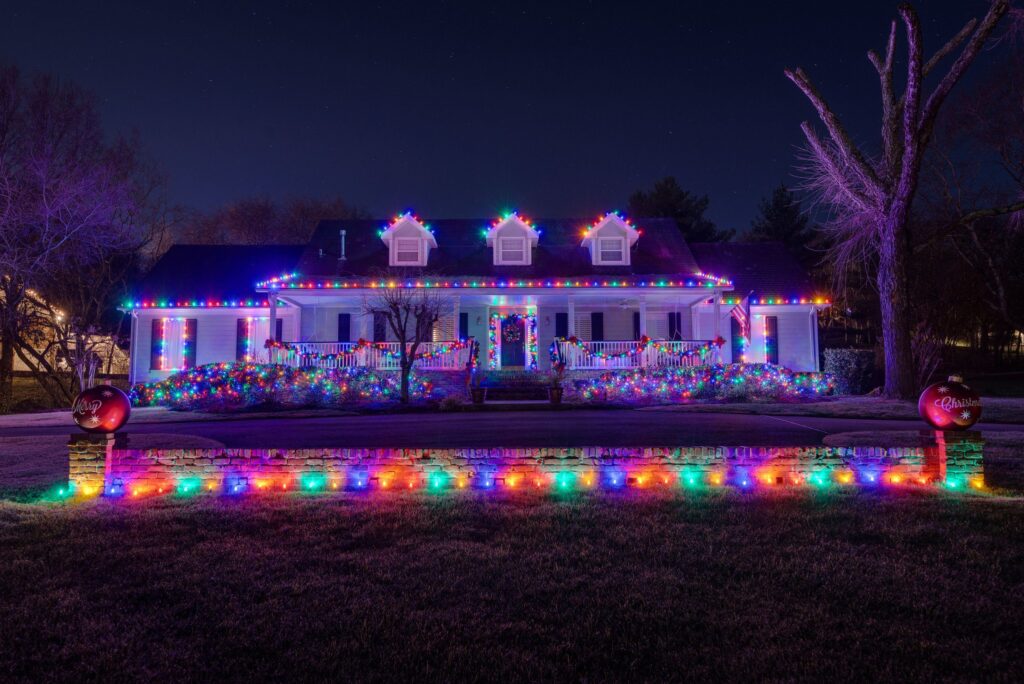
Want your home to look like this?
Red Nose Lites designs, installs, maintains and takes down custom Christmas lighting across Nashville and Middle Tennessee. No ladders, no tangled strands, no storage.
Get a Free Quote