Every fall we get the same question on the phone. The customer has a few boxes of lights in the garage from a big box store, they worked well enough last December, and they want to know why an installer would bother with anything different. It is a fair question, and the answer is not “because ours are better.” The two products are built for different jobs.
Here is what actually separates commercial grade Christmas lights from the retail sets, part by part, plus the cases where the retail set is honestly the right call.
They are engineered for different lifespans
A retail strand is designed to be cheap enough to sit on a seasonal endcap in October, light up a porch railing or a small tree, and get thrown in a bin in January. If it lasts three seasons, the manufacturer met the goal.
A commercial grade strand is designed to be cut to length, rewired with new plugs, hung on a two story roofline, left out through a Middle Tennessee winter, taken down, stored, and hung again the following year on a different section of the same house. That is a much harder job, and almost every physical difference between the two products traces back to it.
Wire gauge and the jacket around it
The wire is the first place you can see the difference without any tools. Pinch a retail strand between your fingers and then pinch a commercial strand. The commercial wire is noticeably thicker and stiffer.
Commercial strands are typically built on heavier zip cord, the kind sold as SPT-1 or SPT-2, with SPT-2 carrying the thicker insulation of the two. Thicker wire matters for two reasons. It carries current for longer runs without heating up, and it survives handling. A strand gets pulled over a gutter lip, dragged across shingle grit, coiled, boxed, and uncoiled. Thin insulation scuffs through at the exact points where the strand bends over an edge. Thicker insulation does not.
The heavier jacket is also what makes a strand worth repairing. If a section gets nicked, a commercial strand can be cut and a new plug installed. On a thin retail strand it is usually not worth the labor, so the whole thing goes in the trash.
Connections are where most failures actually start
When lights go dark in the middle of December, the bulb is rarely the culprit. The connection is. Water gets into a socket or a plug junction, corrodes the contacts, and the run downstream goes out.
Commercial sockets are molded tighter around the bulb base and shed water better. Commercial plugs and end caps seal instead of just clipping together. On a professional install, unused female ends get capped rather than left open and pointed at the sky, which is one of the most common problems we find on homes that were lit by someone else the year before.
There is also the question of how many strands you can safely run end to end. Every strand has a maximum number of connected runs printed on the tag, and retail sets have a low limit because of that thin wire. Commercial strands allow longer continuous runs, which means fewer extension cords snaking across the roof and fewer junctions sitting outside in freezing rain.
Bulb retention
Bulb retention sounds like a small thing until you are looking at a dark gap in the middle of a ridge line in January.
Retail bulbs are usually a friction fit. They hold fine on a tree that never moves. On a roofline they work loose. Wind lifts the strand, the strand snaps back against the shingle, and over a few weeks the bulbs at the highest tension points back out of their sockets. Commercial bulbs seat more positively, often with a locking or twist retention design, and the socket grips the base rather than simply resting against it.
This matters more in Nashville than people expect. Our winters are not consistently cold. We swing from a sunny 60 degree afternoon to an ice event and back. That freeze and thaw cycle works everything loose over a season.
Custom cut is the part you cannot buy in a box
This is the real gap, and it has nothing to do with the components. A retail strand comes in a fixed length. Your roofline does not.
So you either come up short and stop the line somewhere awkward, or you run long and stuff the extra strand behind a downspout or coil it in a gutter. That coil is what a lot of homeowners are actually looking at when they think their lights just look a little off. The spacing is inconsistent and the line does not terminate at the corner.
Every install we do uses custom cut commercial grade LED strands. The strand is measured and cut to the actual run, and a plug is installed at the end, so the line starts at one corner and stops at the other with even spacing the whole way. You can see it from the street even if you cannot name what you are seeing. That process is laid out on our how it works page.
How they go on the house
Materials only matter if the attachment method is sound. We use clips sized to the roof edge or the gutter lip. Never staples, nails or screws into fascia, trim or shingles. A staple gun is faster and it is also how you end up with holes in your trim and compromised shingles that you find in April.
When store bought lights are perfectly fine
We will say this plainly, because it is true and because you should not pay for something you do not need.
- One small shrub or a single porch column. A retail set is fine. Buy it, plug it in, done.
- A tree you can reach from the ground without a ladder.
- A wreath, a railing, or anything you will bring inside at night.
- Interior lighting of any kind, where none of the weather sealing matters at all.
The case for commercial grade material starts when the lights go on a roofline, when they will be out for six to eight weeks in weather, when the run is long enough that connections and voltage drop come into play, or when you are on a ladder to install them. That last one is not about the lights. It is about the ladder.
Getting a price
You do not need an appointment to find out what your house would cost. Call (615) 595-9686, describe the home and what you want lit, and we will quote you on that call. If the property is large or unusual, or you simply want us to look at it in person first, we can come out, but a site visit is an option and not a requirement.
You can also send the details through the quote form. Every install includes design, custom cut commercial grade LED strands, installation by insured crews, in season maintenance, takedown after the holidays, and off season storage, so the lights live with us for eleven months of the year instead of in your attic. There is a 24 hour service guarantee during the season, and no contracts.
We have been doing this in Nashville since 2006. More detail on homes is on our residential installation page, storefronts and offices are covered under commercial installation, and if you want the local page, start with Nashville Christmas light installation or Brentwood.
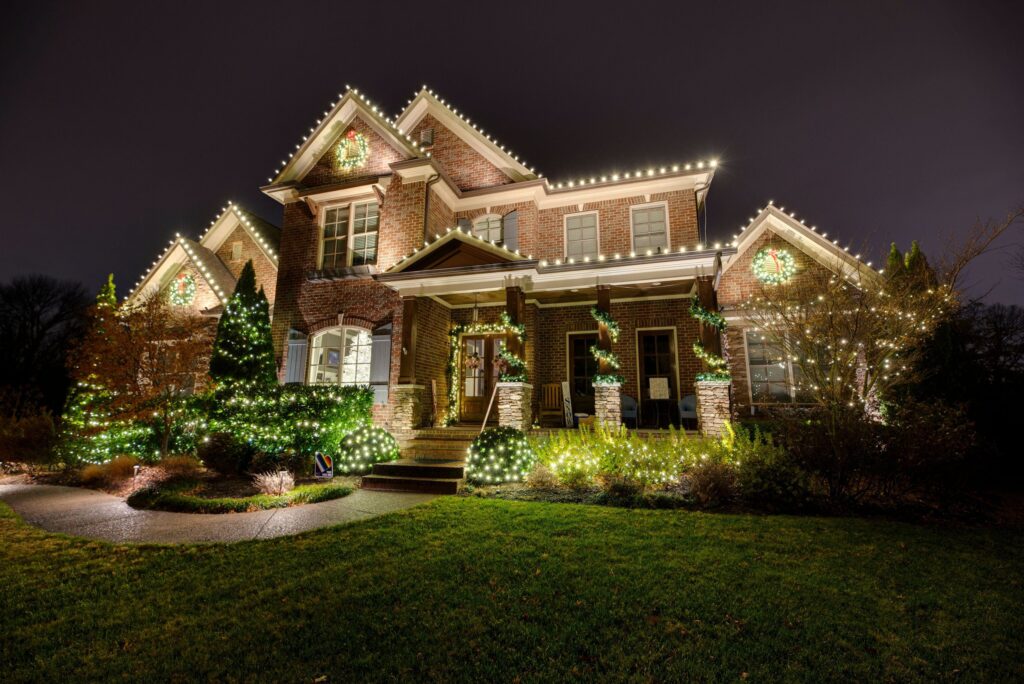
Want your home to look like this?
Red Nose Lites designs, installs, maintains and takes down custom Christmas lighting across Nashville and Middle Tennessee. No ladders, no tangled strands, no storage.
Get a Free Quote